

The Math of Cheating: Why Doping Could Be Trail Running's Next Big Problem
Misaligned financial incentives may be quietly creating a perfect storm. Here's how we might fix it.


It started with a Substack comment from the recent Western States champion.
One of the cool things about this platform is that you can read an article from someone like Caleb Olson, reply, and actually get a thoughtful response in return.
Caleb had just written about a recent episode of the Allen Lim podcast (How to Become a Pro Cyclist) where Lim questions whether doping is even performance-enhancing when you factor in all the mental, physical, and emotional costs.
I recommend reading Caleb’s full post for context, but it was his final question that really got me thinking:
Do you feel like the drawbacks of doping outweigh the performance enhancement? If so, are clean athletes the ones at a competitive advantage?"
My gut reaction: almost certainly not.
If doping weren’t effective, or if the risks truly outweighed the rewards, people wouldn’t do it. But they have (and do). Across endurance sports.
Why? Because the math works out.
Imagine a game where you flip a coin:
Heads, you win $100.
Tails, you lose $1.
You’d keep flipping, right? You could make a living off that coin.
That’s what doping can look like when the incentives are misaligned. The potential upside is massive, the downside minimal or unlikely.
Which got me wondering:
In a sport like trail running, where popularity, prestige, and prize money are all growing, are we unintentionally creating the perfect conditions for doping to take hold?
And more importantly, could we design financial incentives that actively discourage it?
Can we use financial and economic levers to incentivize staying clean?
The Problem Statement
So what’s stopping us from doing more to prevent doping in trail running?
I’m no expert in athlete doping, but I did spend some time down the rabbit hole, especially with this excellent 2023 Trail Runner Magazine article that outlines the landscape.
From what I’ve gathered, there are three major challenges:
1. No Unified Anti-Doping System
Trail running is a patchwork of independent races and organizations, which makes consistent anti-doping enforcement tricky.
WADA (the World Anti-Doping Agency) doesn’t cover most trail events unless an athlete is already in the testing pool from another sport. Only a handful of races, like Western States, use WADA-approved post-race testing.
Others rely on the Quartz program, run by Athletes for Transparency (AFT). But Quartz isn’t really an anti-doping initiative as it’s framed around athlete health. In fact, AFT’s chairman said out right in 2023: “Doping doesn’t concern us”.1
Quartz can disqualify athletes for flagged substances (including some not on WADA’s list), but it doesn’t make those disqualifications public or report results to WADA. This has led to growing frustration from athletes who see it as opaque and inconsistent.
In contrast, races like Mammoth Trail Fest and Pikes Peak Ascent recently shifted to USADA (the U.S. Anti-Doping Agency), which more closely aligns with WADA standards. Mammoth’s race director (and pro trail runner), Tim Tollefson, was blunt:
“As my conversations began with the Golden Trail Series and Salomon, I was upfront about my concerns about the Quartz program. There could be a benefit of that system, but it isn’t anti-doping. We want to align ourselves with credible agencies that can be objective to be able to protect the integrity of the sport. We just have to take those steps. We’re at a tipping point where, if we don’t take a stand, our sport is at risk of becoming cycling in 10 to 15 years, and I won’t stand for that.”
So right now, we have a messy mix: WADA, USADA, and Quartz. Each with its own banned substance list, enforcement style, resources, and level of credibility.
2. Inconsistent Testing at High-Stakes Races
In trail running, career-changing opportunities hinge on a few big races results. A Golden Ticket, or a podium at a UTMB or Western States, can be the difference between part-time hustle and full-time pro.
And yet, testing isn’t consistent, even at the top events.
After placing 1st and 2nd at The Canyons 50K earlier this year, Boulder Boys Seth Ruhling and Matt Daniels seemed shocked when they reflected on the lack of post-race drug testing.
That’s a problem. If athletes at the elite level aren’t sure when, or if, testing happens, the deterrent effect starts to disappear.
3. Drug Testing is Expensive
Testing doesn’t just appear at finish lines out of thin air. It’s costly.
Right now, the financial burden falls on race organizers or underfunded agencies. Just look at the top comment from The Boulder Boys Show video linked above:
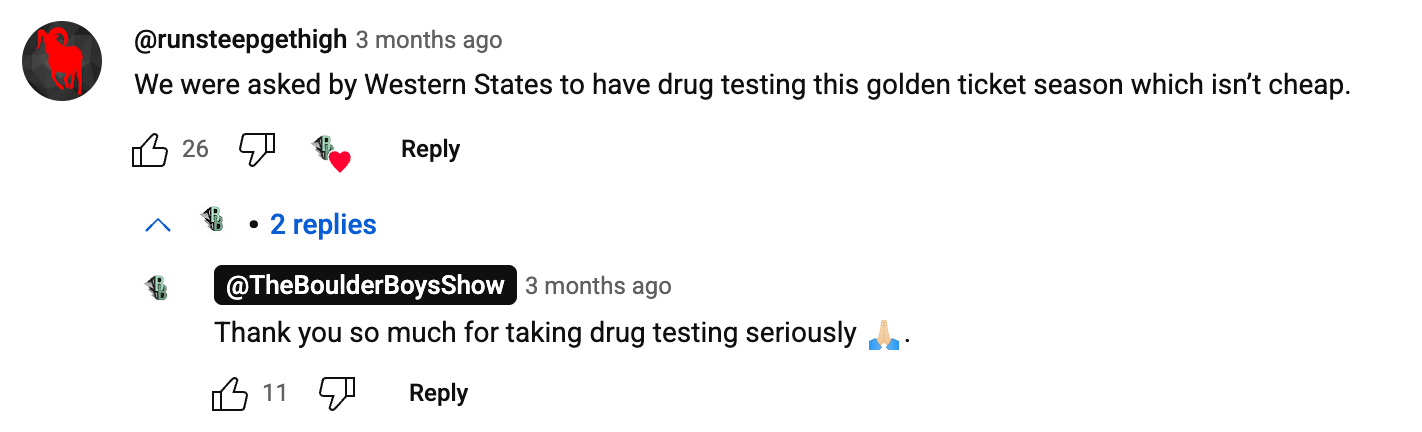
Here, Run Steep Get High (the channel managed by Aravaipa Running CEO Jamil Coury) points out that Western States is asking for drug testing at all Golden Ticket races, including Aravaipa’s Black Canyon 100K.
A single USADA test can cost up to $1,200 once you factor in travel and lab work.2
That’s a huge ask for events and race directors already operating on thin margins.
What Economics Can Teach Us About Cheating
To think clearly about doping in trail running, it helps to borrow a page from economics. Specifically, from Nobel-prize-winning economist Gary Becker.
Becker’s Economic Theory on Crime
Becker’s theory3 on crime reframes illegal behavior not as a moral failing, but as a rational choice4. In his model, people commit crimes when the expected benefits outweigh the expected costs.
In other words, it’s not just criminals vs. non-criminals. It’s people doing the math (consciously or not) and choosing the option that offers the highest perceived payoff (i.e. flipping the coin when the payoffs are asymmetric).
This is the core of deterrence theory. People are less likely to cheat when:
The odds of getting caught are high
The penalties, if caught, are severe
But, and this part is key, Becker also found that increasing the probability of getting caught tends be a more effective deterrent than simply increasing the severity of the punishment.
So, even if the punishment is harsh, it won’t matter much if athletes don’t believe they’ll actually get tested.
Critics of Becker argue that people don’t always behave rationally. But Becker’s response is that even flawed or subjective beliefs still guide behavior. If someone thinks the risk has gone up, they’re less likely to take the gamble.
Which brings us to another useful insight…
Weak Deterrents Can Actually Backfire
In a well-known 2000 study, economists Uri Gneezy and Aldo Rustichini5 looked at what happened when a daycare included a small fine for parents who showed up late to pick up their kids.
The result? Late pickups increased.6
Why? The nominal fine was a weak disincentive that reframed lateness not as a social norm violation, but as a simple transaction.
Parents stopped seeing being late as “bad behavior” and started thinking, Oh, I’m just paying for extra time.
A weak deterrent, in this case, made the behavior feel more acceptable.
This ideas applies surprisingly well to doping. If we set up systems that look like deterrents, but are poorly enforced or inconsistently applied, they may actually legitimize cheating.
They send the message: We know it happens, we don’t really care.
What This Means for Trail Running
Becker’s theory suggests something pretty straightforward: trail runners will be less likely to dope if the costs — real or perceived — outweigh the benefits.
Right now, doping in trail running is feared to be a high-reward, low-risk gamble. The upside (better results, more sponsorships, long-term career boosts) often far outweighs the downside (rare testing, inconsistent penalties, little transparency).
The imbalance needs to shift.
If we want to protect the integrity of the sport, we need to increase the perceived risk of doping amongst elites, either by increasing the likelihood of getting caught or by increasing the severity of the consequences. Ideally, both.
For example, a six-month ban might feel like a slap on the wrist. But a lifetime ban or automatic loss of sponsorship income? That changes the calculus.
A small fine might feel transactional. But the public forfeiture of prize money and endorsement deals could feel devastating.
Even small changes to the risk-reward ratio could have an outsized impact, especially if athletes start to believe they’ll get caught. This isn’t about catching everyone. It’s about making the perceived risk high enough that cheating no longer feels like a rational choice.
There are probably dozens of other ways to apply economic theory to trail running’s anti-doping challenge. My goal here is to simply show that the incentives matter, and that shifting them could change behavior at scale.
Aligning Financial Incentives in Trail Running
Preventing doping in trail running doesn’t require every trail runner suddenly becoming more virtuous. It requires better math.
If there’s little downside and a big upside to cheating, some athletes will cheat. But if the risk increases, through higher chances of being caught or real consequences for doing so, the calculation starts to change.
Here are three realistic shifts that could help reduce the incentive to dope by targeting the three weak points discussed earlier: lack of organization, inconsistent enforcement, and cost.
✅ 1. Brands: Make Drug Testing Part of Sponsorship Deals
If brands want to benefit from clean, inspirational athletes, they should also help ensure that those athletes are clean.
One way to do this? Make random, out-of-competition testing a core requirement of elite sponsorship contracts.
Here’s how it could work:
Athletes agree to periodic testing —randomly or, say, quarterly throughout the year — as a condition to receiving elite level sponsorship support.
Contracts could include clawback clauses and potential terminations for positive tests, aligning the risk directly with financial consequences.
Brands would help cover testing costs and, in return, protect their reputation by associating only with athletes committed to clean competition.
This creates a powerful incentive loop:
Athletes face real, ongoing consequences for cheating.
Brands gain confidence in the athletes they support.
Fans and fellow competitors trust that top-tier performances are earned, not enhanced.
By raising the cost of doping and shifting some of the burden to companies that benefit the most from athlete success, this approach strengthens both the integrity of sponsorships and the broader culture of the sport.
✅ 2. Races: Add a Testing Tier for Elite Entrants
Not every runner needs to be tested. But the ones racing for prize money and professional contracts? That’s where the testing matters most.
Race organizers could introduce a “testing tier” as part of elite registration. Here’s how it might work:
Elites opting into this tier pay a slightly higher entry fee, with a portion going directly to fund drug testing.
These athletes become eligible for prize money, Golden Tickets, or automatic entries into major events.
Everyone else — age-groupers, mid-packers, back-of-pacers — register at the standard rate, forgo testing, and are ineligible for cash or automatic qualifiers.
This approach does three things:
It targets resources where they matter most. At the front of the field.
It makes financially incentivized performance contingent on accountability.
It shares the burden evenly between the athletes who stand to benefit and the events that promote them.
No system is perfect, but this kind of tiered model keeps things scalable and financially realistic while still moving the needle on deterrence.
✅ 3. Majors: Standardize Testing at Flagship Events
At the top end of the sport, doping deterrents need to be both visible and consistent.
All major events — UTMB, Western States, Golden Ticket races, etc. — should adopt a mandatory testing protocol for:
Automatic qualifiers
Podium and top 10 contenders
Random selections from throughout the elite field
Costs could be shared between race organizations, title sponsors, and testing-tier athlete registration fees. Crucially, test results should be made publicly available, creating transparency and reinforcing the legitimacy of elite competition.
This kind of standardized approach:
Raises the perceived risk of doping where visibility is greatest
Sends a clear message that all elites will be held to the same standards
Reinforces the sport’s reputation at the events where the stakes are highest
Combined with brand-level out-of-competition testing, this kind of consistent race-day enforcement could go a long way in reshaping the incentive landscape.
Looking Ahead: What Else is Needed?
Aligning financial incentives won’t solve doping on its own. But combined with better organization, clearer infrastructure, and more transparent accountability, it could push trail running in the right direction.
Here are a few areas that still need attention:
✨ 1. Organization: A Central Governing Body and Unified Framework
One of the most promising frameworks for proactive anti-doping came from Arizona-based ultrarunner Charlie Ware, who in 2019 proposed a voluntary, athlete-led testing program after realizing the Quartz program felt more like a health check than a real deterrent.
Ware’s concept, as described in the Trail Runner Magazine article linked previously, called the Ultrarunning Athlete Collective (UAC), focused on out-of-competition testing, the gold standard in most serious anti-doping protocols.
The idea was simple but powerful:
Elite athletes would opt in and pay ~$370/year to fund random WADA or USADA-sanctioned testing.
Race directors could require UAC membership to be eligible for prize money or automatic entries.
Athletes would be part of the USADA Clean Athlete Program, which tracks training and living locations for surprise testing.
Ware even modeled funding and test volume: a small group of ~40 athletes could fund 7–10 randomized tests annually. He had early support from race directors at Western States, Run Rabbit Run, and Aravaipa.
But the initiative stalled when it became clear that positive tests come with real complications, including legal appeals, retesting, and third-party arbitration. All of which require infrastructure and money. Ware estimated a $150,000 fund would be needed just to cover the legal contingency risks.
Still, the groundwork is there. His proposal offers a path toward a legitimate governing body. One that could:
Determine which substances are banned (WADA/USADA lists or otherwise)
Manage athlete whereabouts and random out-of-competition testing
Coordinate sanctions and appeals after positive test results
Partner with brands and races to enforce consequences
As Ware said:
“It’s totally doable. It’s not far-fetched. It just comes down to doing it.”
That next step may require coordination from athletes, race orgs, and brand partners, plus independent administrators to build it out.
✨ 2. What’s Still Missing?
Even with stronger incentives, voluntary testing, and more rigorous protocols at key races, a few important gaps remain:
Funding Stability: All these suggestions require long-term funding independent of any single stakeholder.
Athlete Education: Runners need the opportunity to get up to speed on supplement risks, whereabouts requirements, and banned substance lists.
Legal Infrastructure: Positive tests demand due process. A legitimate appeals process if necessary to preserve trust in the system amidst false positives.
Broader Representation: I’m based in the U.S. and most of these ideas are Western-centric. For trail running to be a truly global sport, anti-doping efforts must eventually involve athletes and orgs from across the globe.
Support for Whistleblowers: Clear processes for anonymous reporting and meaningful protection may be worth exploring.
In short, the foundation is there. But a legitimate anti-doping system for trail running will require coordination, funding, and community-wide buy-in.
✨ 3. What Else?
I don’t have all the answers. I’m just a guy on the internet with some ideas, a background in finance, a passion for this sport, and an interest in making it better.
So I want to hear from you:
Race directors: How would mandatory drug testing impact your operations or bottom line? What role could your event play in a clean sport initiative?
Athlete managers: Have anti-doping clauses started to appear in contracts? Would brands realistically help fund testing infrastructure?
Elite athletes: What does your ideal anti-doping framework look like? Would you support a voluntary testing program like the one Ware proposed?
Everyone else: What other ideas do you have? How can we make meaningful strides towards an effective, trustworthy anti-doping framework in trail running?
Drop a comment, send me a note, or forward this to someone who’s close to the issue. I’d love to learn more and share what I learn in a future follow-up article.
The Aid Station
Quick hits. Trail style. Actionable, digestible, essential.
🎥 Favorite Trail Running Content This Week — Sean Haworth x Max Jolliffe at AC100
Grainy, lo-fi vibes. Perfect soundtrack. Intimate cuts and big emotion. I’m a sucker for this style and I want more of it in my feed.
P.S. Someone hire Sean to shoot your next big race!
👟 Gear Check — Outside Magazine Editors’ Favorite Long Run Shoes
A groups of Outside Magazine editors each chose their long-run shoe of choice. Which was the most surprising? Which, if any, were missing?
As quoted in the 2023 Trail Runner Magazine article.
According to the 2023 Trail Runner Magazine article.
Becker, Gary S. “Crime and Punishment: An Economic Approach”. University of Chicago Bureau of Economic Research. 1974.
Rational Choice Theory assumes that all human behavior is goal directed, with actors seeking to maximize benefits while minimizing costs.
Absolute top-tier names, for what it’s worth.
Gneezy, U., and A. Rustichini (2000)“A Fine is a Price,”The Journal of Legal Studies, 29(1),1-17.
For a deeper dive on this topic, I recommend Jason Koop’s multipart series on anti-doping on his Koopcast podcast. He and Corrine Malcolm deserve credit for advancing a lot of the dialogue and developments. I’m intrigued by your idea to get sponsors to require testing of their athletes, but it’s hard to see this catching on unless it became a widespread bragging & selling point. One thought on your proposals: I think you’re overlooking the desire and potential of midlife age-groupers to cut corners and dope. They’re at a time in life of generally greater financial security (i.e. willing to spend big on their sport) and wanting to fight aging and boost ego with doing well in their age group. I think this demographic, which flies below the radar, may be most susceptible to cheating and justifying it as another hack. It’s a slippery slope from supplements and super shoes and caffeine, exogenous ketones, and Adderall to thinking that some extra testosterone or HGH isn’t so bad or wrong to take. Also, FWIW, I briefly last year took testosterone off label on my doc’s advice for menopausal hormone therapy, which is increasingly common among women my age (over 50). It didn’t do much, and my level remains nearly nonexistent. But when I got into Hardrock this year, I stopped taking it and have remained off it since there’s no TUE for women taking testosterone, which is a banned substance. Although Hardrock doesn’t test, I wanted to be clean on principle. But hormone supplements are increasingly used and justified to get levels back to a normal range. Just goes to show how complicated this is, and although someone can be anti-doping in theory, they can justify using a banned substance if they feel they truly need it to make up for a deficiency.
Thank you for the review and suggestions on a very complicated topic. If illegal PED's in sport were as clear-cut as driving through a red light, we could simply say, "Let's enforce the law!" and quickly figure out how to do just that. Here's a few confounding factors for consideration:
1) We are a drug culture. Everyone takes drugs. Caffeine is by far the most efficacious PED in existence, and it of course is legal. The infamous EPO illegally improves the performance of a few people while also saving thousands of lives every year; alcohol is not only legal but is celebrated, and is responsible for at least a hundred thousand deaths every year. It would be great to draw simple and clear ethical lines, but these lines can be wavy.
2) Sport is supposed to be good for you. HRT can be very good if not vital for one's health, yet is quite illegal, and a TUE is very unlikely. OTOH, the supposed negative health consequences of using illegal PED's turns out to be surprisingly questionable - investigating these claims reveals them to be mostly negative marketing.
3) So the main reason to establish and enforce PED guidelines is to create a level playing field, especially for professionals with a paycheck at stake. This is definitely a valid reason which I support. However, the concept of "level playing field" itself is slippery - the average cost of a hyperbaric chamber is $8,000, which pro athletes use regularly, and which runners from poorer backgrounds can't possibly afford. But they can afford a pill given to them with a monthly dose costing maybe $100. Paying for a coach is now standard practice, which again many runners cannot afford, and the crew support at aid stations top runners have nowadays requires a major outlay of time and money. So have we created rules that favor our peer group while keeping others out?
4) The testing is problematic. A runner friend who does peer reviews for scientific studies marvels at the standard method of the "A and the B sample". Why would sample A ever test different than sample B? If it does just 5% of the time that means the test has a margin of error of 5%, which is too high for any scientifically valid test.
It's tricky, but we'll keep working at it! Again, let's keep in mind the real goal is for a level playing field.