

The Cringe Doesn't Matter
The SATISFY x adidas Circle Pit was loud, the discourse was louder, and the business logic was clearer than either.


You’re road tripping through the Arizona desert. It’s 100 degrees and you can’t wait to find a gas station to cool down. You see something up ahead. Lights, but it’s not a building. As you get closer, the noises come into focus. Music, screaming, a gong. People running and skateboarding around what looks like a makeshift track. This is neither an oasis nor a gas station.
You’ve stumbled upon the SATISFY x adidas Circle Pit.
“Never listen to anyone. My playbook is not their playbook.” - SATISFY founder Brice Partouche speaking to Office Magazine
The Circle Pit was an invite-only event featuring runners and influencers circling a pump track to a soundtrack of punk and hardcore music. It served as an activation for the recently announced SATISFY x adidas collab, which features three colorways of the latter’s Adios Pro 4 road shoe plus co-branded apparel as part of a multi-season partnership between the brands.
If you’ve opened your inbox this week, you’ve seen the reaction. Nearly every running newsletter has a strong opinion about the event, most landing on some combination of “cringe”, “corny”, and “failure.” The consensus is that the collab, and the event in particular, did little to help the brand equity of either company in the eyes of the broader running community. One exception was Chris Z’s article, “The Satisfy x Adidas Subculture Heist,” which broke down the Circle Pit substantively and leveled its criticism through the lens of historical punk and hardcore culture. It’s a layer of context I valued, even if it’s not my lived experience or something I feel qualified to speak on.


My take is that life is too short, and everyone should be entitled to do things that bring them joy, especially when those things are as harmless as a pump track in the desert. I find it more fulfilling to dig into why things happen than to dwell on the parts I don’t agree with. That’s my take. Everyone is entitled to their own, and everyone can vote with their wallet. If you don’t like SATISFY, don’t buy their products.
This article uses the Circle Pit to focus on the why instead of the what. Why did an event like this happen, what does it signal about the business side of the sport, and what might it tell us about where the trail running economy is heading? Whether you liked it or not, a collab starts to make business sense once you understand that the trail economy is actually multiple economies running in parallel, and the layer in between is where all the action is.
Two Trail Economies and the Layer Between
When we think about the trail economy, it’s easy to place brands in one of two buckets:
Incumbents
Large, public companies or conglomerates with quarterly cycles where trail running is rarely a primary line item. Think Nike ACG, adidas, HOKA (Deckers Brands), Salomon (Amer Sports), On, Brooks, ASICS, The North Face (VF). Nike alone is twice as large as Deckers, Amer Sports, On, Brooks, and ASICS combined1.
Insurgents
Small, bootstrapped startups. These are single-thesis bets at scales incumbents can’t economically pursue. They’re focused on proof of concept, brand awareness, and growing sales volume while optimizing costs to improve margins. Think Tantrums (hydration vests), Dera (running belts), Open Fuel (sustainable nutrition), Terignota (accessible trail apparel), and Speedland.


The Middle
It’s easy to think of the incumbents and insurgents as two parallel economies on either end of a spectrum. The space in between these two extremes, which I’ll simply call “the middle,” is the most interesting.
The middle isn’t a fixed category. It’s a position on the spectrum. Insurgents graduate into it through VC funding, strategic capital, scaling growth, or rising cultural awareness. Incumbents shop in it through collaborations seeking credibility, or through product design choices that defend their moats (I’m old enough to remember when Nike was accused of copying SATISFY’s Moth Tech).
A few brands in trail running’s current middle:
SATISFY: $11.8M (€11.3M) Series B in 2025 led by Felix Capital.
norda: strategic investment of an undisclosed amount from the Ermenegildo Zegna Group.
Tracksmith: $8M Series B led by Causeway Partners, plus a line of credit from Dwight Funding to provide working capital for production.
Nnormal: strategic investment from Camper combined with the credibility of Kilian Jornet.
Mount to Coast: total capital undisclosed, but operationally well-funded and growing fast.
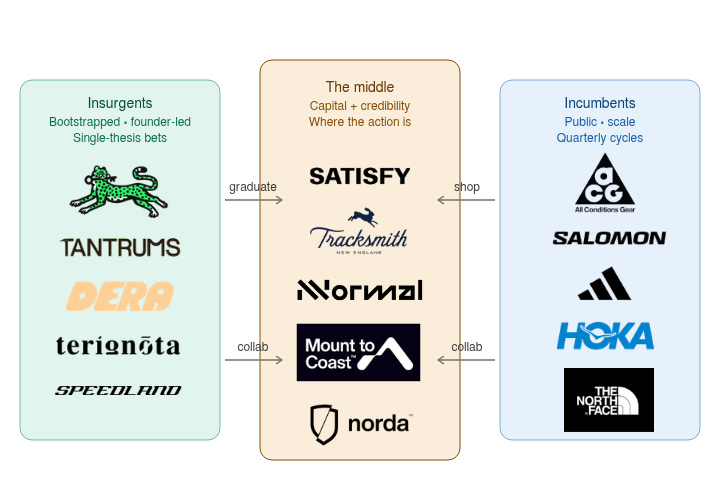
This list isn’t exhaustive, but the theme is consistent. This middle is where the most interesting things in trail are happening, and there are several reasons why.
Why the Middle is Where the Action Is
The middle has features that don’t exist at the extremes. For smaller brands, it offers capital to act at scale. For larger brands, it can offer credibility to act with authenticity that insurgent companies build from scratch.
Capital flowing downstream
Brands with proven product/market fit attract institutional investors looking for scale and multiples on their investment. That capital enables insurgent brands to graduate further to the right on the spectrum. This capital can mean the difference between a niche lifestyle brand and a scaled mainstay.
Strategic collaboration upstream
For lack of a better description, incumbents use the middle as a way to launder credibility. Adidas can’t tap into SATISFY’s audience organically. SATISFY has spent a decade building it. The collab solves that problem while giving SATISFY access to a new cohort of customers through an established adidas shoe line. It’s also not new ground for SATISFY, which ran similar collabs with Salomon (2018) and HOKA (2023).
Internal middle activity
Middle brands also collaborate with each other to mutually benefit from higher profile and access to new customers, sometimes pulling insurgents further across the spectrum in the process. Think norda x SATISFY in 2022 or Tracksmith x Ciele.
The middle is where running’s most consequential moves are happening, regardless of whether the community finds them aesthetically agreeable.
The Circle Pit as Case Study
While the Circle Pit was largely an activation for a new road shoe, it involves brands that are entrenched in the trail running scene. It’s also a good case study for the types of collaborations we might expect more of in the future. We can expect more because these types of collabs make business sense for the brands involved, whether we all agree on the execution or not.
Plenty of people disagreed with the execution of the Circle Pit. Many defended it. But not all criticism is the same.
“Hardcore has always had a simple, imperfect rule: everyone can become part of it, as long as they show up with respect and give something back. You do not need a perfect biography. You do not need permission from the other kids. But you cannot just take the symbols, the shirts, the language, the tension, the dirt, and the danger, filter them through fashion, price them like fashion, and sell them back as culture.
That is not appreciation. It is exploitation.”
- Chris Z in “The Satisfy x Adidas Subculture Heist”
Chris’s critique is the sharpest and most valid in my opinion because it’s more structural than emotional. It’s grounded in personal context and substance of the event itself, not in a disagreement with the vibes or an opinion on how things should have been done. Rather than critiquing running culture, he’s using the historical context of the punk and hardcore scenes being appropriated to critique the appropriation itself. That’s a meaningful distinction amidst the noise.
That said, this event happened, and events like this will continue to happen, because it makes business sense. The cringe discourse doesn’t matter unless it meaningfully changes purchase behavior, and it almost certainly won’t. Existing SATISFY customers buy for the product and aesthetic, neither of which was diminished. New potential customers are being introduced to the brand through all the buzz the event generated. Some will vibe with it, some won’t. People who already don’t like SATISFY still won’t.
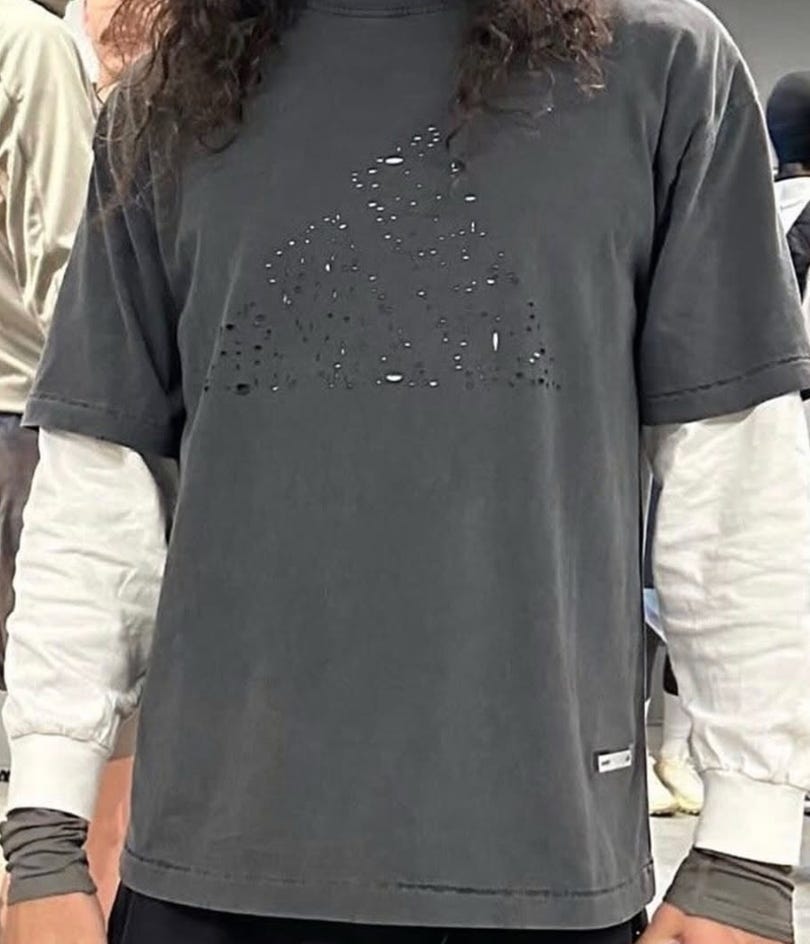
For adidas, this collab solves a problem they can’t solve internally. They produce world-record marathon shoes, but can’t create the same credibility alone that they hope to gain through association with SATISFY. The Circle Pit and collab are essentially rented credibility. Whether or not it works remains to be seen, but even the haters can admit the Moth Tech logo tee looks pretty cool.
For SATISFY, this is what growth-stage investors expect. As much as we love the small, authentic brands that serve as the backbone of trail culture, investors have lofty expectations when they put $11M into a company. Felix Capital didn’t fund SATISFY for them to stay a niche Paris brand. A multi-season partnership with one of the largest sportswear companies in the world is exactly the kind of move expected to generate a return.
The trade-off: SATISFY pays an authenticity tax for scale, while adidas pays cash for the credibility with SATISFY’s base it can’t generate on its own. The running community absorbs the cultural noise as the byproduct.
I’m not arguing this collab or the Circle Pit event are “good for running” or that the event was flawlessly executed. I’m just pointing out that it makes business sense for the brands involved, regardless of how the community feels about it. Whether the trade is culturally worth it is a separate question, and a legitimate one, that will play out over time. But the business logic is real.
The Cringe Will Fade. The Collabs Will Continue.
My prediction: the cringe debates will fade in a matter of weeks. The shoes will undoubtedly sell out. SATISFY will grow its revenue, while adidas shifts its cultural penetration in running (for better or for worse, you decide).
As trail running continues to grow and become more culturally relevant, I expect these types of collaborations to continue. I don’t anticipate this will be the last one the broader community disapproves of or calls cringe. But understanding the business logic behind these events lets us strip out the emotional investment and see them for what they are: brands in the middle of the trail economy seeking scale, awareness, or a return on investment.
The trail economy is becoming large enough that not every brand needs to speak to every customer. Support the ones you love. Avoid the ones you don’t. Just remember there’s almost certainly a business reason for everything that happens, whether the community finds the spectacle comfortable or not. That’s the era we’re in.
I know there are some strong opinions out there on this topic. Let’s hear ‘em.
The Aid Station
Miscellaneous quick hits. Trail style. Actionable, digestible, essential.
🎥 BARGAIN BOYS PODCAST | EP 18 | Cocodona 250 Rundown featuring Cody Poskin
I loved this interview between Dan Green (2025 Cocodona champion) and Cody Poskin (2026 men’s runner-up, 3rd overall). It’s an entertaining and illuminating look at Cody’s race, and the authenticity from both guys shines through.
🎙️ Randi Zuckerberg on Long Run Labs
This conversation between Jonathan Levitt and Randi Zuckerberg resonated with me, especially the parts on financial vs. intrinsic motivation and stepping off the hedonic treadmill. As someone still learning to be more comfortable in my own skin, it was validating to hear someone like Randi, successful by any metric, echo the same journey.
🐆 ICYMI: Open Fuel x Trail Waves Discount
A few weeks ago, I wrote a deep dive on Open Fuel’s values-based business strategy, and Zach (co-founder) was kind enough to create a discount code for Trail Waves readers. Just enter TRAILWAVES2 for 25% off at checkout.
My personal favorite is the Radical Raspberry Ripple and I’m also excited to try their new gel mix. You can read more about Open Fuel below:

Based on most recent annual revenue figures.
Affiliate link. I earn a small commission from any purchases. Win-win.
I appreciate your analysis, definitely helps make sense of this, especially from a business perspective. I agree with Chris Z’s take on this too.
I’d also love to see an authentic punk trail brand emerge, Satisfy just isn’t. Nowhere close. A DIY ethos and accessibility are central to punk, and in that regard Terignota and Open Fuel are way closer than Satisfy. Sure, on the surface it may not look like it with the colors and designs etc. but the authentic DYI origins of the brands, the accessibility and so on remind me way more of a punk ethos than Satisfy. In fact, Terignota and Open Fuel kind of remind me of legendary PNW garage punk band Dead Moon mastering and cutting their own vinyl records on their own vintage lathe. As real as it gets.
But to each their own. I did like seeing Satisfy sponsor Molly Seidel, that was cool.
I (maybe begrudgingly) agree that this likely won't prevent the shoes from selling out...but I'm curious to see what longer term damage will be done by the entitled/whiny responses from a lot of people involved with Satisfy.
Very good analysis on that "middle" segment of brands. IMO Mount2Coast has been the funnest growth to watch, especially since it's almost purely product driven