

125 Hours vs. Zero
Cocodona delivered 125 hours of livestream coverage. The Canyons 100K, with six Golden Tickets and a stacked field, got none. A business-lens look at why, and how to fix it for the future.

By the time this hits your inbox, the Cocodona 250 will have been live for more than four full days. If you’re anything like me, this week has been an exercise in trying to be productive without getting sucked into the 24/7 livestream.
I continue to be amazed by what Aravaipa and Mountain Outpost pull off: continuous coverage of a 250-mile race, gaps at night aside, with the ability to rewind to key moments whenever I had a free minute. Every time I checked, somewhere between 8,000 and 12,000 people were watching, with peaks above 40,000 during Rachel Entrekin’s record finish. We can debate how to make the coverage more compelling, but the demand for live trail running coverage is clearly at an all-time high.
Which is ironic, because what was probably the race of the year went down at the Canyons 100K the weekend of April 25th and none of us got to watch the drama unfold. One of the six Western States Golden Ticket races, and a UTMB umbrella event, didn’t have a livestream.
Three Americans swept the men’s podium: former Western States champion Adam Peterman (HOKA) took the win, The North Face’s Zach Miller finished second to secure his first WSER appearance, and the decorated Hayden Hawks (HOKA) snagged the final Golden Ticket. On the women’s side, ACG’s Riley Brady smashed the race to claim their WSER spot after falling short at Black Canyon. A compelling day of racing, almost entirely unseen.
Brett Hornig, co-hosting an episode of The Singletrack Podcast, put it bluntly after the race:
“I’ve followed races closer via Twitter in 2012 than I was able to with UTMB’s tracking at Canyons [in 2026].”
For those of us following along, we refreshed the UTMB live tracker religiously, hoping it would actually register splits and not mix up time zones. That was the most drama we got all day. The final Golden Ticket race, with six tickets on the line in a stacked field, was reduced to results posts and recap shows.
The best coverage of the race came from Hans Troyer’s personal vlog.
Canyons wasn’t a coverage failure. That would imply someone tried to cover it. We’ll dig into what happened, why it may have happened, and where the sport goes from here. If this was a business decision, it was the wrong one for the sport.
The Problem: A Missed Opportunity
This might not seem like a big deal to some, but the lack of livestream is a missed opportunity for UTMB, HOKA, and fans alike.
The Canyons 100K is the final Golden Ticket race before Western States, and a “Super Golden Ticket” race where the top three men and women all earn automatic WSER entries1. The storylines coming into the race were rich:
Riley Brady’s redemption arc. Could they secure a Golden Ticket after missing out at Black Canyon in February?
Adam Peterman’s quest for WSER return. The former champion graciously walked it in last year after blowing his quads. He’d want to come back and race his best in a competitive field.
Miller vs. Hawks. Reigniting the rivalry from the 2016 TNF 50-Mile, with Golden Tickets on the line this time.
Each of these played out, yet didn’t get the shine they deserved. What’s perplexing is that 2/3 of the Canyons course overlaps with Western States, so we know a high-quality livestream of this terrain is possible.
So why no broadcast?
Four Potential Business Explanations
The answer likely falls into one of four buckets.
1. Lack of expertise or technology
The argument: UTMB lacks the know-how or the tools to put on a high-quality livestream.
The reality: Demonstrably false. UTMB delivers great coverage for the UTMB Finals, which I’d argue are harder to broadcast than Canyons given the Alpine terrain. They also stream select races across their umbrella, most notably the “majors” on each continent. In 2024, UTMB delivered 165+ hours of coverage and 16 million views across 8 events, expanding to 12 streamed events in 2025. The technology exists for this exact terrain. WSER’s broadcast uses Starlink on the same trails. If UTMB can stream 12 events per year, Golden Ticket races should be among them.
2. Lack of resources
The argument: Livestreams are expensive and cost significant resources that UTMB doesn’t have.
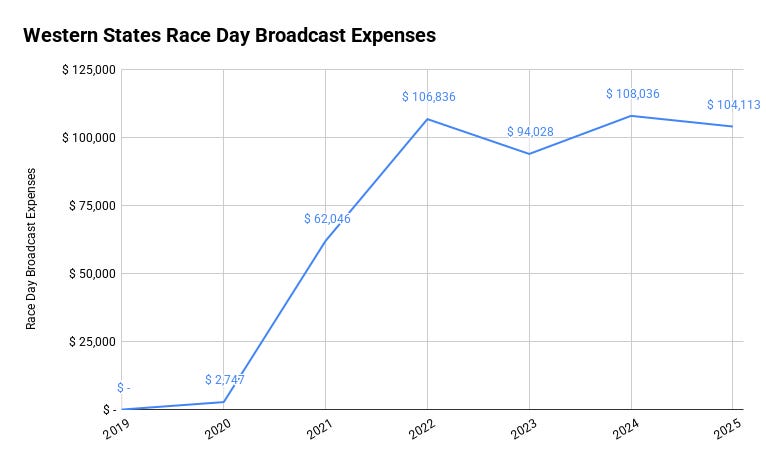
The reality: Thanks to the WSER Foundation’s Form 990, we know what it costs to broadcast Western States each year (2025 total: $104,113). At less than 2/3 of the distance, Canyons shouldn’t cost more.
UTMB, meanwhile, generates significant revenue from registrations. As a private company, we don’t see their financials, but we can infer. Typical 100K registration fees run $350-$400. With 678 starters, that’s ~$237,000 to $270,000 from the 100K alone, not including any registrants who didn’t start the race. Add the 100-mile (243 starters), 50K (630), and 25K (323), and I’d estimate UTMB cleared $500,000+ in registration revenue from the Canyons weekend. More than enough to support a livestream.
3. Business decision
The argument: UTMB decided that the benefit of a livestream at Canyons wasn’t worth the dollars, time, and logistics to put it on.
The reality: This is the most likely explanation. UTMB made the same call at Chianti earlier this year, initially planning to livestream Courtney Dauwalter at Tenerife before the race was cancelled. Ironically, Dauwalter ended up at Chianti, which went uncovered like Canyons.
The pattern is a tell. The expertise exists, the revenue exists, and yet Golden Ticket races keep falling outside the broadcast plan. The most likely reason: they’re not considered “key events” within the walls of UTMB.
4. Strategic prioritization
The argument: UTMB’s budget concentrates on races within its own ecosystem, where the ROI flows back into Running Stones and UTMB World Series engagement, not into Western States.
The reality: A more charitable version of #3. Chianti and Canyons are both part of the UTMB ecosystem but aren’t UTMB Majors2, so they matter more to WSER as Golden Ticket races than to the UTMB Finals. From a pure P&L view, the decision tracks. Compounding the misalignment, HOKA presents both WSER and Canyons, meaning the brand is most positioned to demand coverage benefits either way.
This is rational from inside UTMB’s walls. But Golden Ticket status is granted from outside them. UTMB is a private company entitled to make its own business calls. But that designation is a privilege granted by WSER, and that privilege should come with obligations that prioritize the sport, not just private companies.
Four Potential Solutions
Now that we’ve covered the likely explanations, let’s walk through what could keep this from happening again in 2027 and beyond.
1. UTMB builds livestream into its race business model
For Golden Ticket races like Canyons and Chianti, a livestream gets baked into race-day expenses. That likely means higher entry prices, other races in UTMB’s ecosystem subsidizing livestreams for the minority, smaller per-race margins, or some combination.
Pro: This is the fastest, cleanest fix and preserves the current schedule.
Con: Requires UTMB to absorb a cost without a direct return to its ecosystem, presumably one reason it didn’t happen in the first place.
2. HOKA earmarks sponsorship dollars for broadcast
As part of any presenting sponsorship, HOKA could require that some or all of its payment go toward live coverage, alleviating the cost and margin concerns from option #1.
Pro: Aligns incentives. No brand benefits more from live coverage of a stacked Golden Ticket field than the presenting sponsor, and UTMB’s brand becomes associated with compelling livestreams.
Con: Complicated by HOKA’s dual role as title sponsor of both WSER and UTMB. HOKA already contributes to the WSER Foundation and supports Canyons as the presenting sponsor. Should only the Canyons dollars be earmarked, or some of the WSER sponsorship as well?
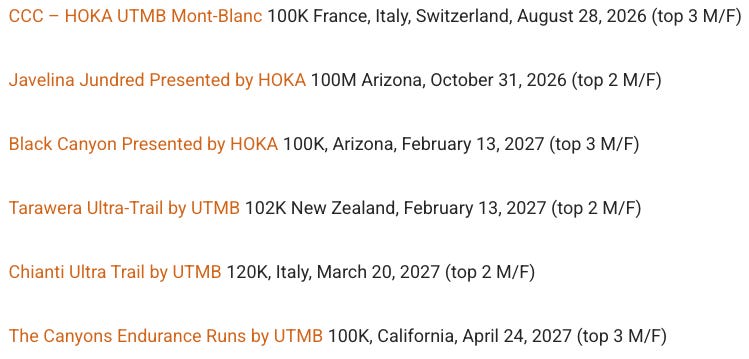
3. Drop UTMB races (except CCC) from the Golden Ticket schedule
To avoid conflicts of interest and diversify the calendar, perhaps the best long-term solution is one where CCC is the only UTMB Golden Ticket event.
Pro: WSER has leverage and alternatives. Black Canyon and Javelina (both Aravaipa, via Mountain Outpost) already livestream. The Big Alta 100K could replace Canyons as the spring California 100K with no drop-off in course quality and likely better coverage. Separate presenting sponsors per race might also make the Golden Ticket calendar feel more differentiated.
Con: The WSER/UTMB partnership has value beyond any single race, so reducing UTMB’s share could have downstream impacts not obvious from the outside. It may also make finding competitive European Golden Ticket options harder.
4. Contract Mountain Outpost (or equivalent) for the broadcast
Bring in an organization that already has the expertise, technology, and logistical know-how.
Pro: Reliable, high-quality, viewer-familiar production at a known cost (~$100K based on WSER expenses). The “plug and play” option where UTMB just allocates resources. Coverage stays consistent across Golden Ticket races alongside Black Canyon and Javelina.
Con: Doesn’t solve the underlying question of who pays, and asks UTMB to outsource a capability they already have. It’s also unclear how the cost translates to European races like Chianti.
None of these solutions are perfect, but all of them beat the status quo of no livestreams.
What This Means for the Sport
Every Western States Golden Ticket race should have a livestream. UTMB should prioritize it. HOKA (or future presenting sponsors) should require it as part of sponsorship agreements. Fans should speak loudly in support.
The 2027 Golden Ticket schedule was recently released and is identical to 2026. Three of the six races are UTMB events. Without a change, this shortfall could happen again. And again.
For trail running to grow, it needs to be watchable when it matters most. And that requires a livestream that both exists and is high-quality. Cocodona’s rise in popularity is due in large part to Aravaipa and Mountain Outpost streaming it for 125 straight hours. It doesn’t have more elite talent than Canyons, but it offers a portal where fans can follow their favorite runners and watch the drama unfold.
Trail running is at a moment where it can either build the casual-to-fan funnel or stay a participant sport. Livestreaming the biggest races is table stakes for any growth to take place.
UTMB’s choice not to broadcast Canyons is theirs to make. They’re a company that needs to earn a profit, and they’re accountable to ownership and a board. But if Golden Ticket designation — a tag that drives entries, prestige, and registration revenue — comes with no coverage obligation, that’s on HOKA and the WSER Foundation to help address.
Cocodona shows the demand for live trail running coverage is real. The demand is likely even higher for a competitive race like Canyons. Let’s learn from this missed opportunity and deliver a better product for everyone in 2027.
The best race of the year deserves better than a vlog.
The Aid Station
Miscellaneous quick hits. Trail style. Actionable, digestible, essential.
🐐 Jim Walmsley is BACK AT WESTERN STATES!
Jim Walmsley is officially back on the Western States start line! The four-time champion was added to this year’s race via a HOKA sponsor spot, rounding out the best Western States lineup of all time. Jim reflected on this development with a lot of grace and humility via Instagram:
Seth Ruhling’s comment sums up how much of the trail world feels about Jim’s return for Western States:

🌵 Rachel Entrekin Wins Outright
Speaking of GOAT’s, what Rachel Entrekin did at Cocodona is beyond words. After finishing 1st woman in 2024 in 73:31:25, Entrekin won again in 2025 in 63:50:55 before winning outright this year in 56:09:48, a new course record by more than two-and-a-half hours.
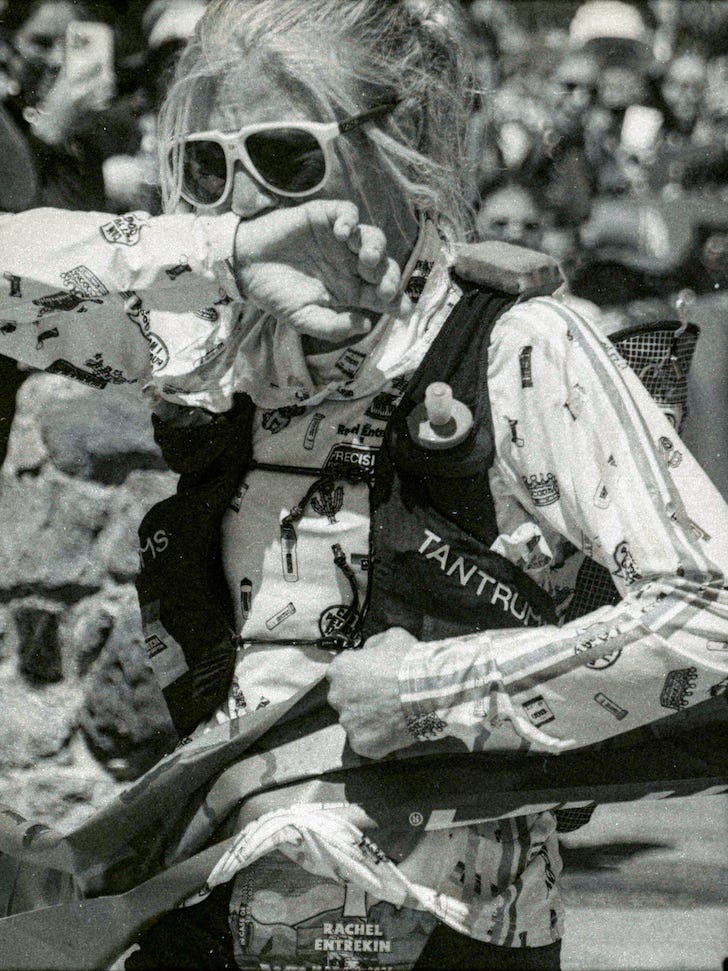
It was a brave, gritty, and impressively fast race that continues to challenge our beliefs of what is possible. Her mantra for the race? Why not me? Indeed.
🌊 Big Cocodona for Friends of Trail Waves
I was especially stoked to see some good friends of this newsletter having success and getting much deserved exposure at Cocodona.
Rachel Entrekin crossed the finish line in the yet-to-be-publicly released Roam 11 vest from Tantrums. The vest is now available for pre-order here.

Open Fuel’s Zach Hauer also made the pilgrimage from Black Canyon City to Flagstaff, finishing Cocodona in 69:23:03, good for 11th place. I followed his journey throughout the race and was stoked to see him cross the finish line.

Finally, Rendezvu athletes Kilian Korth (2nd), Cody Poskin (3rd), Megan Eckert (8th), and Jeff Garmire (10th) all finished in the top ten of Cocodona. Check out their Rendezvu profiles to see the gear they used in the race.

Congratulations to everyone involved with Tantrums, Open Fuel, and Rendezvu!
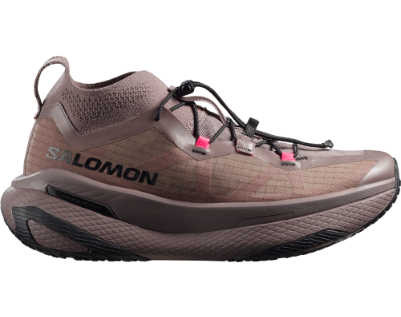
👟 Salomon GRVL Concept Release
Salomon is back with another gravel shoe, this time with it’s GRVL Concept. For the space between road and trail, it features the explosive cushioning of road running “super shoes” and a grippy, gravel-tuned sole and protection. The GRVL Concept retails for $250 and is available now.
Technically, the tickets can roll down to 6th place on each side if higher-finishing runners decline the ticket or are already in Western States and don’t need a ticket.
Kodiak is the North American major, while Valdaran is the European major.
The real problem is that Hoka only allows WSER to choose golden ticket races off of a limited menu - "WSER has leverage and alternatives" is completely false. They have zero leverage and almost zero alternatives.
The responsibility is on Hoka to step up, not UTMB. If Hoka is going to demand that only a certain limited set of races be GT-eligible, then it's on them to make sure the races meet the quality one would expect from a GT.
Another great one, Seth. Thanks. I’d say beyond just establishing the live streaming capability for these races, once established they need to improve and mature as well. Learning form other more mature endurance broadcasts like cycling, the live streaming graphics and commentary should focus on the placement of the racers relative to each other, time apart, closing gaps, etc. Mountain post is a good attempt but still amateurish in its delivery. But step #1, get cameras out there! Thanks again.