

The $29 Moat
The shorts cost $11.98 to make. The $80 pair in your drawer costs about the same. Inside the open books and business strategy of Terignota, trail running's most transparent brand.


Financial information is strategic. Companies generally decide what you get to know and when. For the most part, the less information customers have, the better for the company.
But that’s not always the case.
In college, I took a class called Seminar in Financial Reporting Theory, a fancy way of saying we analyzed how public companies report their numbers to their investors and the market. One week, we looked at a study where companies appeared to have managed earnings,1 through accounting estimates and adjustments to them, in ways that signaled good news to the market without divulging sensitive information. If a company like Apple were about to release a product that would drive significant revenue, it might adjust its estimates to report positive earnings now, telegraphing good news without giving away trade secrets.
I found this fascinating, both because I assumed companies generally try to be opaque and because, as an Accounting major, I assumed financial reporting was boring and straightforward.
Every purchase is a form of negotiation. A company tries to convince you to hand over money (through marketing, discounts, demos, etc.) in exchange for a product. Usually the only information we’re privy to is the price, the materials, and what competitors charge for something similar. We pay $80 for trail shorts not because they cost anywhere near that to make, but because we’ve accepted that’s the normal price for trail shorts. As consumers, we’re negotiating mostly blind.
Enter Terignota, the one-man trail brand founded by Alex King, which is flipping that idea on its head. It sells $29 shorts, publishes transparent financials, and builds a brand in public in a way few other brands do (or can). Terignota refuses to pull the levers other brands treat as the status quo, and that refusal is itself the differentiator. By negotiating out in the open, it isn’t just offering a lower price. It’s handing the consumer information they’d otherwise never see, shrinking the asymmetry until all cards are on the table. As Alex put it to me recently:
“We want to dispel the notion that inflated prices lead to inflated performance.”
Is this strategy? Authenticity? A bit of both? I sat down with Alex to understand how the brand came to be, the intentionality behind its model, and why it’s a strategy most brands literally cannot copy.
The Origin Story
It’s March 2026 and I’m at the Big Alta 100K, volunteering at Big Rock aid station (mile 54) with ice sponges. As the leaders came through, I noticed a woman cheering loudly for Alex King until he was out of sight. She let us know she was Alex’s mom, and after he set off on the final section of the course (eventually finishing 7th), she spent a few minutes telling us how hard he’d worked to build his business and how proud she was of him. I’d heard of Terignota and had seen runners wearing it on course, but didn’t know the full story.

The brand came together at the confluence of three things happening in Alex’s life at once:
A decade-plus chasing high-level trail running as the sport got more expensive. Alex spent years dedicating time and money to the dream of becoming a paid professional, and in the process realized how costly even basic gear had become.
A post-collegiate job at Naish Kiteboarding. Alex studied mechanical engineering in college and admittedly has “always liked designing and tinkering and stuff.” At Naish, he worked as a product designer and spent a lot of time overseas in factories in China and Taiwan. This gave him a look behind the curtain of the production process including, importantly, how little a brand actually pays the factory, and how many middlemen take a cut along the way. He recalls Naish paying around $30 to manufacture a piece that needed to sell for $400+ for everyone in the chain to make money.
A tiny home business pulling work and running in opposite directions. Alex rented out an old cow barn and used it to build one tiny home per year, spending the rest of the time running. He enjoyed working for himself, but the two pursuits were fundamentally at odds:
“Six months out of the year I would get momentum in my work life but my running would kind of fall by the wayside, and then six months out of the year my running would get momentum but I would have like zero dollars…so they were taking me in different directions and I could never really get momentum in [both].
I wanted to kind of combine my work and just like combine my life into something that I’m more passionate about in the community I want to be in.”
The first inkling for starting Terignota came from a pair of socks. On a training trip to Boulder, Alex stopped into a local running store and paid $50 for two pairs. He knew there had to be a better way:
“I don’t have $50 to spend on two socks…I don’t know how I’m going to keep doing this.”
With no experience in apparel or soft goods, he started experimenting with making his own gear. First, sourcing cheap socks on Alibaba, then eventually materials for shorts and shirts. After six months of iteration, he had a product he was happy with and ordered samples just in time for CCC.
Even with everything seemingly aligning, there was still doubt.
Alex had quietly built out the Terignota site before the race, before telling anyone or fully deciding if he wanted to go through with it. Then word got out. A post-race beer with Ryan Thrower, a respected figure in the trail community who was immediately enthusiastic, was the nudge Alex needed. In November 2024, with “literally $5,000 to my name,” he took out three credit cards with 0% interest periods, maxed them out, and placed a $20,000 order: 500 shirts, 500 shorts, 200 socks, and 200 hats. He opened pre-orders for that first batch and figured he could survive on 50 items sold per month.
He was eventually able to clear that 50-item bar and turn Terignota into a fully-functioning business. How he did it warrants a closer exploration.
The Business, Economics, and Challenges
Terignota’s business model is simple, but the way it’s executed is worth exploring. The company charges significantly more modest prices for common trail gear than other brands, not as a loss-leader, but because the economics make it possible. Its goal? Making trail running accessible to all.


Cost Transparency
The Sendero Shorts retail for $29 and cost $11.98 to make. The Trail Tee sells for $22, a 3.5x markup on its $6.11 per unit cost. The Valhalla Vest, one of the brand’s first forays into functional gear, is priced at $89, a 2.3x multiple of its cost. Similar items from other well-known brands cost at least twice as much. All costs are fully landed, meaning they include shipping, tariffs, and anything else required to get product from the factory to Terignota’s virtual shelves.
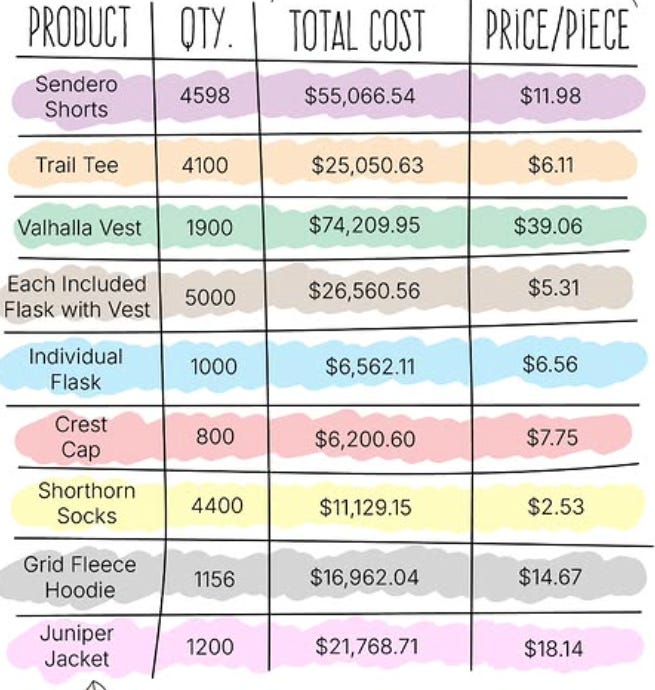
What makes this more than just a pricing strategy is the transparency layered on top of it. I asked Alex what he wished more people understood about the brand:
“I think it goes back to my hope that people start learning what they’re paying for, not necessarily only in trail running, but just on a broader aspect of life…I hope people realize that all these brands are paying very, very similar amounts for shirts, shorts, whatever. And yeah, most of your money is not going to those shorts and shirts.”
Revenue and Profitability
Terignota’s most recent financial report shows total revenue of $917,332 since inception, with the most recent six months ($586,244) more than doubling the prior period ($249,065), an annualized run rate of ~$1.17M.
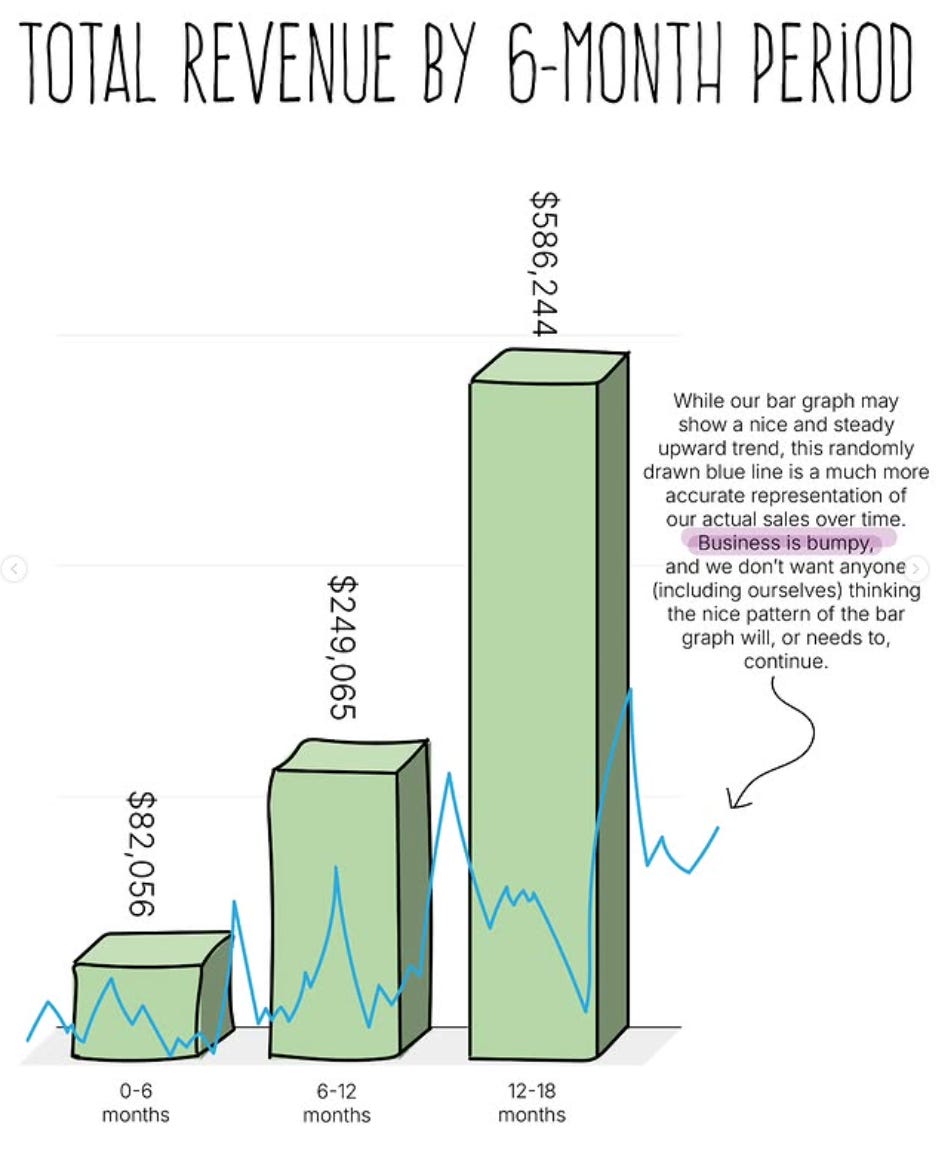
The report shows $120,855 in total profit, though that figure includes $122,415 described as amounts paid to manufacturers for inventory not yet received. Technically, under accrual accounting, that’s not really an expense. It’s a prepaid asset representing cash paid now that will generate revenue once the goods arrive and sell through. Adjusting this out, Terignota has generated ~$243K in profit on $917,332 in sales, for a 26.5% profit margin.
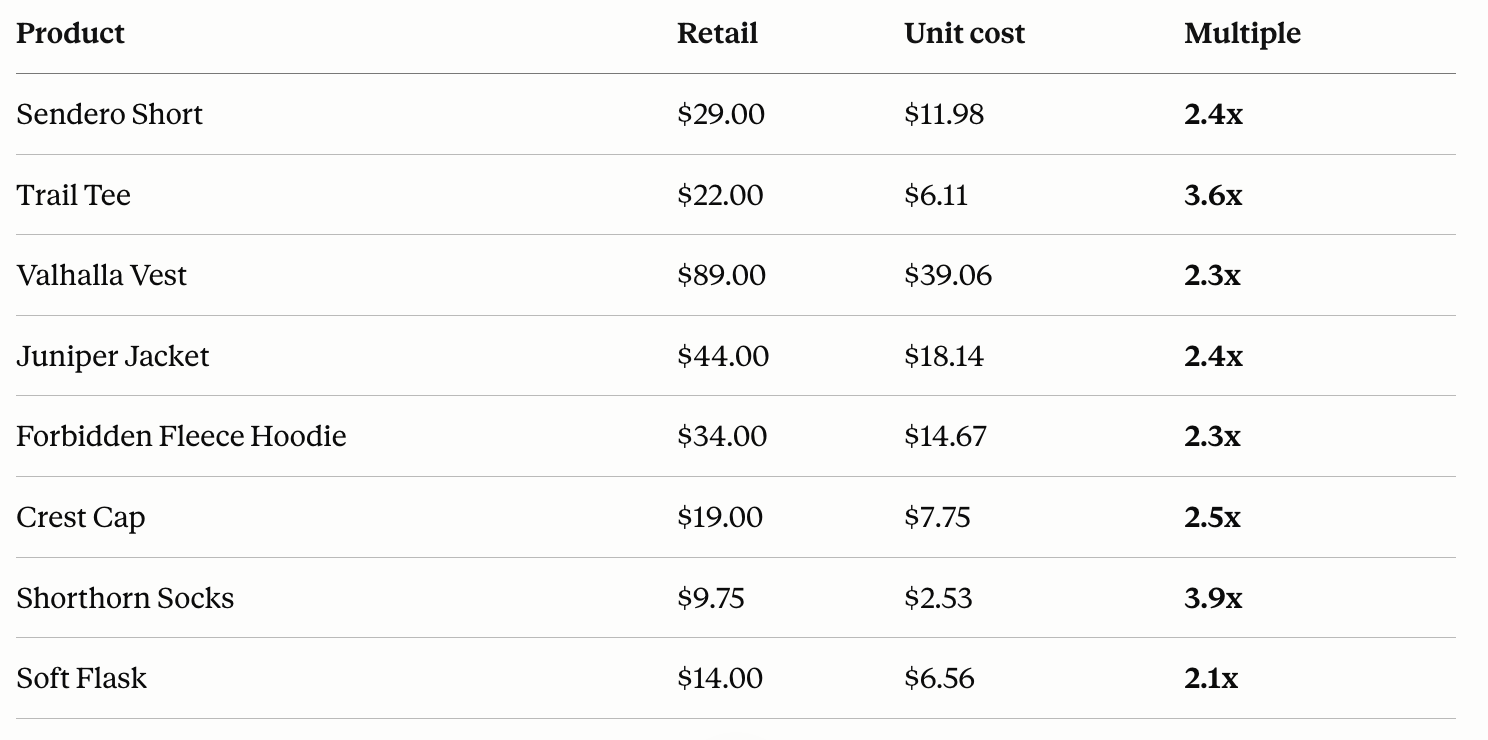
I told Alex he could raise prices 10-20% and still look cost-effective relative to the competition. He pushed back in a way that suggested he’s heard the argument before:
“It’s just such a slippery slope. [Say] I increase my prices by 30%, then I make more money, then I’m just going to spend that money on something. Then I’ll increase my prices by 30% again and then all of a sudden I’m just another brand that sells shorts for 80 bucks or whatever and I don’t think we need any more of those…
…If we can make a sustainable, profitable business on $22 shirts and $29 shorts, that’s what we’re going to do.”
Debt and Financing
Apparel brands typically pay factories upfront and recoup those costs through later sales, a cash flow lag that requires working capital. For a one-man operation, that means financing.
The 0% credit cards covered the first run. Once Terignota had enough sales history, Alex took out over $52,000 in Shopify loans at high (12%+) interest rates that have since been paid off. Today, one item of debt appears on the balance sheet: $45,438 of a $60,000 loan from his parents at a favorable 4% interest rate.
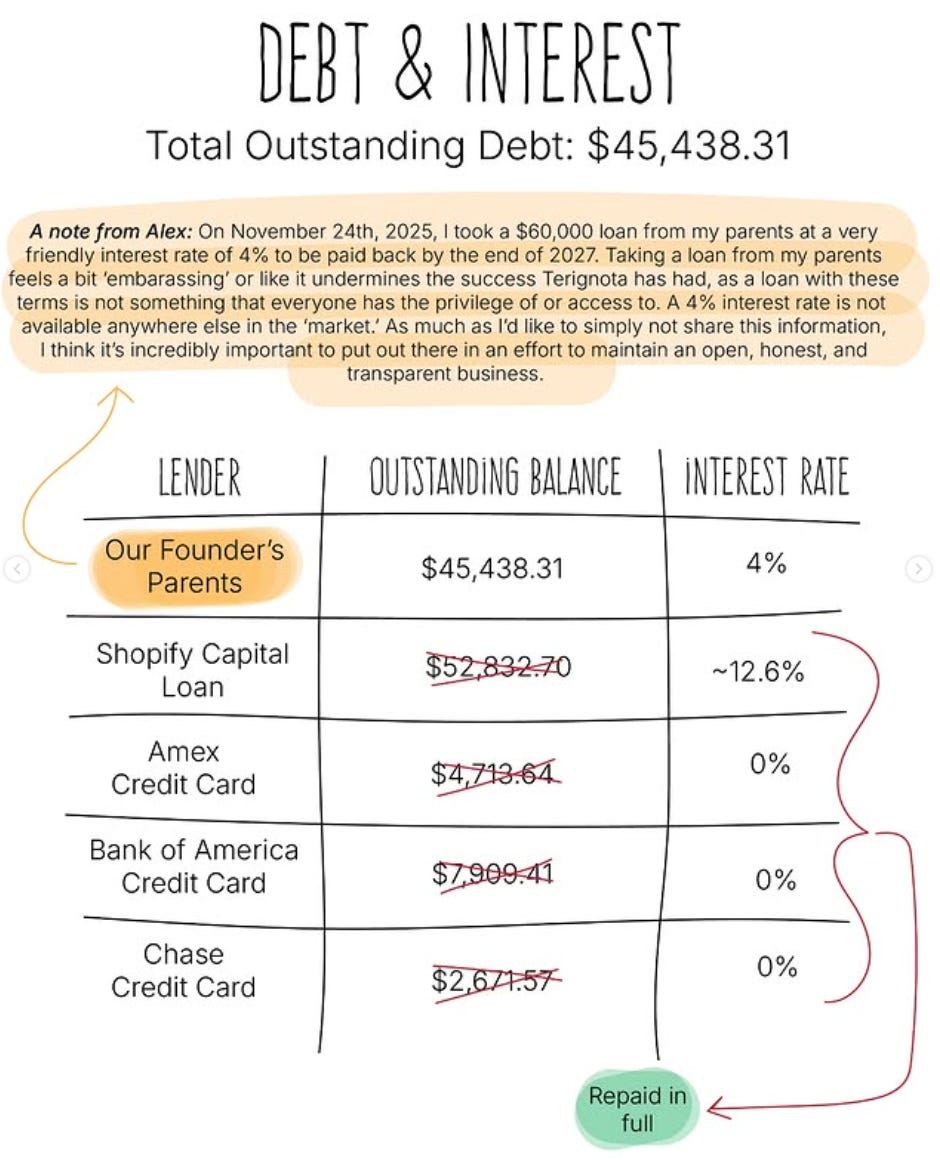
Each financing round has been cheaper and more personal than the last, the inverse of a typical startup, which raises progressively more expensive and more institutional capital. Alex is upfront about acknowledging that “not everyone has the privilege of or access to” family financing. But I find it hard not to appreciate the same mom displaying pride for her son at an aid station is also the one who put money behind her belief in what he’s building.
The Anti-Flywheel
It’s typical for brands to use paid marketing as an acquisition tool and growth lever. Just look at your Instagram feed. Every brand curated specifically for your tastes is paying Meta for that impression, that click, that conversion. Much of that spend gets built into the price and passed along to the customer to preserve the brand’s gross margin.
Alex doesn’t want any of that with Terignota. His theory:
“I think pushing things into people’s faces is in a lot of ways worse. It does the opposite of what you actually want it to do. I would both [have to] raise my prices and I would be pushing things on people which makes people much less likely to tell their friends about it or talk about it.”
He means it, and the financials prove it. Just $4,484 in lifetime marketing expenses (0.49% of total revenues against direct-to-consumer norms as high as 10-20%+) and $0 in ads in the last twelve months. For context, the report also shows $38,083 paid to Shopify in transaction fees, 8.5x his lifetime marketing spend. Accepting credit cards has cost Terignota much more than advertising.
But is this theory correct? Alex’s no-ads stance reads as philosophy, but does the math back it up?
The chart below explores the relationship between customer acquisition cost (CAC) and customer lifetime value (LTV). CAC is what you pay (mostly to Meta and Google) to turn a stranger into a customer. LTV here is the gross profit that customer generates across their lifetime of orders.
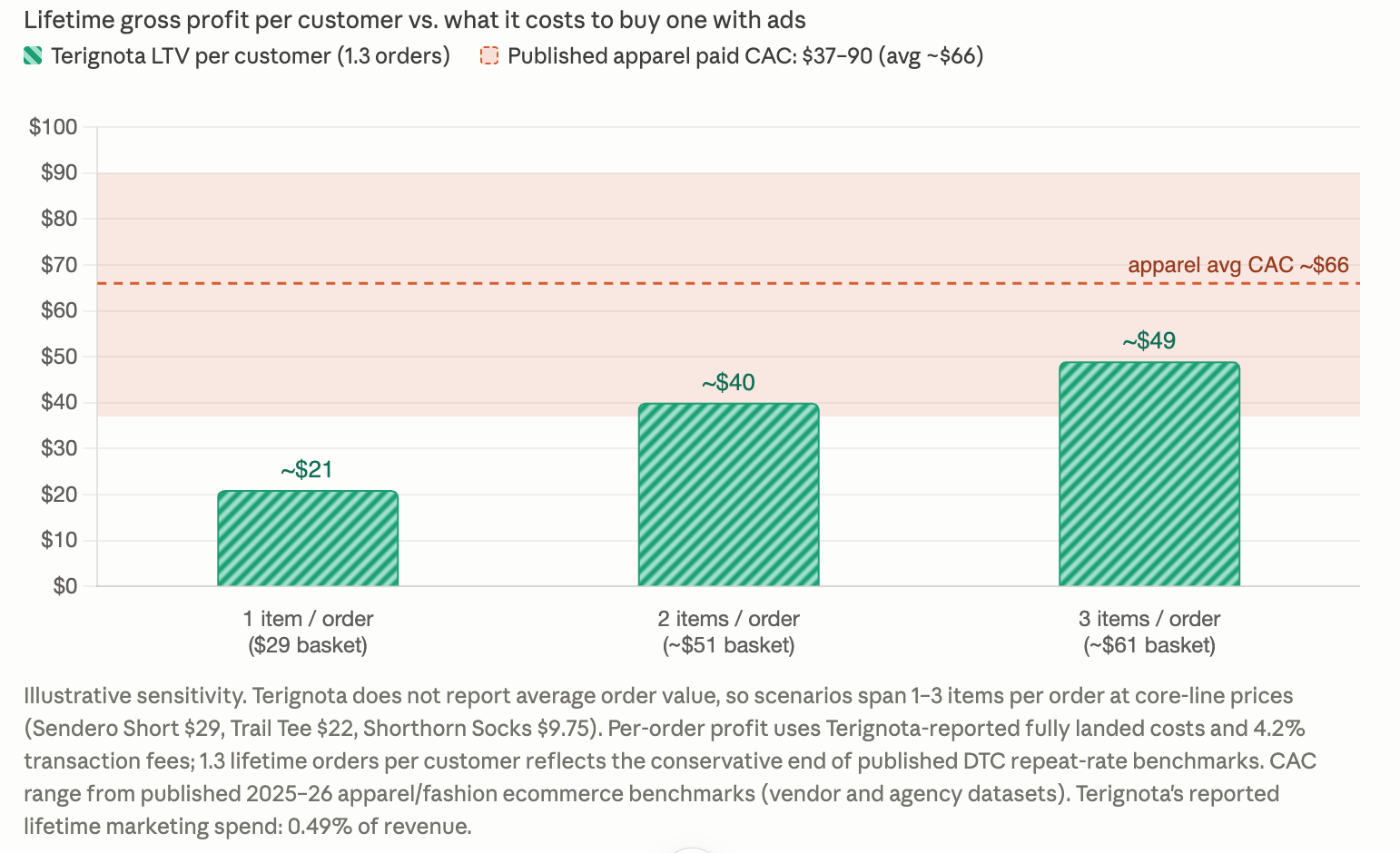
The green bars show Terignota’s estimated lifetime gross profit, built from information published on the website and in its financial reports, assuming an average of 1.3 orders per customer, the conservative end of published DTC benchmarks2. Since Terignota’s average basket isn’t public, I ran three scenarios: (1) one pair of Sendero Shorts, (2) Sendero Shorts + a Trail Tee, and (3) Sendero Shorts + Trail Tee + Shorthorn Socks.
The coral band is what apparel brands actually pay to acquire a customer through paid advertising3.
Every scenario falls below the industry average CAC line, meaning if Terignota spent as much on ads as the average direct-to-consumer apparel brand, it would necessarily have to raise its prices to create a profit. At the midpoint, the average DTC apparel brand spends more acquiring a customer than that customer will generate in lifetime gross profit at Terignota’s prices. The lower end of the range is more forgiving, but clearing it would require a level of paid marketing efficiency most established brands don’t hit, let alone a one-man operation.
Terignota isn’t just charging lower prices. It reconfigured the flywheel to optimize for organic, word-of-mouth growth instead of marketing-driven scale and brand awareness. That’s a clear tradeoff that Alex is making intentionally. It also shows why other brands charge as much as they do. The $80 shorts we’re accustomed to aren’t necessarily made from 2-3x better materials. They exist within a flywheel that spends money to acquire customers. One pays for the other.
Alex skipped marketing and opted out of the price architecture that exists to pay for it.
Why It’s Hard to Copy
Most trail brands carry sponsorships, ad budgets, marketing departments, and other headcount that require positive cash flow to support. Terignota is essentially just Alex. For the same pair of trail shorts, other brands need to charge more just to break even on overhead. Alex can price close to cost because he has almost none.
Competitors literally cannot compete on price with Terignota. That inability to respond is the moat.
Alex compounds this advantage through transparency. He provides regular financial updates and doesn’t hide the fact that a $29 pair of shorts costs less than $12 to make. He’s publishing exactly where that margin goes. His most recent financial report disclosed $11,000 to his bank account, $8,750 toward retirement, and $41,543 for living expenses. That’s $61,293 over 18 months, or ~$41,000 annualized.
Matching that level of transparency or leanness would require incumbents to disclose executive compensation, channel margins, and per-product markups, all of which would unearth realities of these companies’ cost structures that they’d prefer to keep vague.
Even a brand that could match the economics couldn’t manufacture the authenticity. Most companies are profit-seeking by design. Yes, Terignota is too, but the deeper motivation appears to be building something that lets Alex align his work, his lifestyle, and his passion for trail running.
That framing shows up in how the brand has grown. Alex estimates that he’s sent out roughly 10 free pairs of shorts in the entire life of the company. Rachel Entrekin, champion and course record holder at the Cocodona 250, wore Terignota’s Sendero Shorts for a large portion of that race. Alex had sent her gear simply because they’d known each other for many years. He didn’t expect her to race in it, let alone smash the course record. It just happened.

You can’t reverse-engineer that. “I would never want to push anything on anybody” is more personality trait than formal brand positioning. And it shows up in the product, the pricing, and the way the brand has grown. It’s difficult for any incumbent to copy that.
The Long Game: A More Informed Negotiation
Alex’s north star is modest: stop packing boxes and answering customer support emails all day, get back to designing, and someday launch a full trail running line (including a shoe). No five-year plan, no lucrative exit. In his words:
“I don’t really have a five-year vision for the brand other than to just keep doing what we’re doing in the way we’re doing it. It’s always just like the next puzzle to solve and the, I mean, that’s what I like doing so as long as we stay true to our values I think we’ll end up somewhere good.”
Terignota has already announced two new products coming this summer: the Tahoma Half Tights ($14.33 landed cost) and the Sagebrush Sun Hoodie ($9.13 cost). Applying the same multiples that define the rest of the product line, we can expect pricing around $33-$36 for the half tights and $21-$24 for the hoodie4. In addition to the two new items, restocks of existing products are expected in July.
In a world where financial information is guarded, Terignota’s real differentiator may be the information itself. It provides transparency and credibility that the price you’re paying more closely reflects what the thing is actually worth.
“Most of your money is not going to those shorts and shirts.”
Once you know that, every purchase becomes a slightly more informed negotiation, whether you buy from Terignota or not.
Alex’s only ask when I pressed him for a call to action was to “try something out and tell a friend about it.” The full range of Terignota products can be found here.
During our conversation, I selfishly asked Alex about pushing through doubt and finding confidence to share an idea before you’re sure it’s ready. I’ll leave you with his response, as I think it applies to almost anything, whether that’s building a brand, writing a newsletter, or chasing any dream you can’t shake from your mind:
“There’s so many factors pushing against you to do anything uncomfortable. I think maybe the biggest is just [that] I have no right to be an apparel designer or make apparel. There’s no evidence that says I should be good at that…It’s so easy to make reasons and there are so many reasons why you shouldn’t do it and it would be easier not to.”
Not only did he start, but he’s taking us all along for the ride. Stoked to see where Terignota goes from here.
The Aid Station
Miscellaneous quick hits. Trail style. Actionable, digestible, essential.
🎙️ Second Nature Podcast: “What Happens When You Actually Ask for Help”
Morgan Tuohy recently launched Dera, the brand that created the B01, the first adjustable dial-fit running belt. Writing this newsletter has found me rooting for founders and small brands who are betting on themselves, taking chances, and doing something different than the status quo. It’s these types of brands that help keep the sport of trail running pointed in the right direction as it grows.
I was lucky enough to get on the initial pre-order list before it sold out, but they are back in stock. This is hands-down the best belt I’ve ever tried, and I have no affiliate with the brand. I just love it that much. Check it out and learn more through this great conversation Morgan had with Second Nature!
⛰️ TrailCon and Western States!
Short Aid Station this week, but lots of exciting stuff on the horizon. I’ll be heading up to Tahoe for TrailCon on Monday, June 22nd and will be in town through Western States. It’s my first time ever spectating WSER and I’m so excited for a front row seat. If you’ll be in town and want to meet up, let me know!
The use of discretion within accounting rules (including the timing of revenue recognition, accrual estimates, and reserve adjustments) to shape how a company's reported numbers look. It's distinct from fraud: most of it is legal judgment calls inside Generally Accepted Accounting Principles (GAAP).
Assumes 1.3 lifetime orders per customer, derived from DTC repeat-purchase benchmarks of ~19–30% (BS&Co. analysis of 156,000+ DTC customers; Finsi)
Published 2025–26 benchmarks for paid customer acquisition in apparel/fashion ecommerce range from ~$37 (Ringly) to ~$90 (Eightx), averaging ~$66.
Author estimates based on price multiples. Actual SRPs may vary.
Terignota is the coolest and most interesting brand in trail running right now. A dude in a garage sending out cheap but quality gear through word of mouth by himself is 1000 times more "punk" than anything Satisfy has ever even imagined doing.
Thank you Seth, you get us. Somehow reading this financial analysis of Terignota made me tear up with pride. To add to the chart in the 'Anti-flywheel' section:
Terignota's average order value is $66.25 (including shipping & taxes)
Our average customer spend is $98.74 implying 1.5 lifetime orders per customer.