



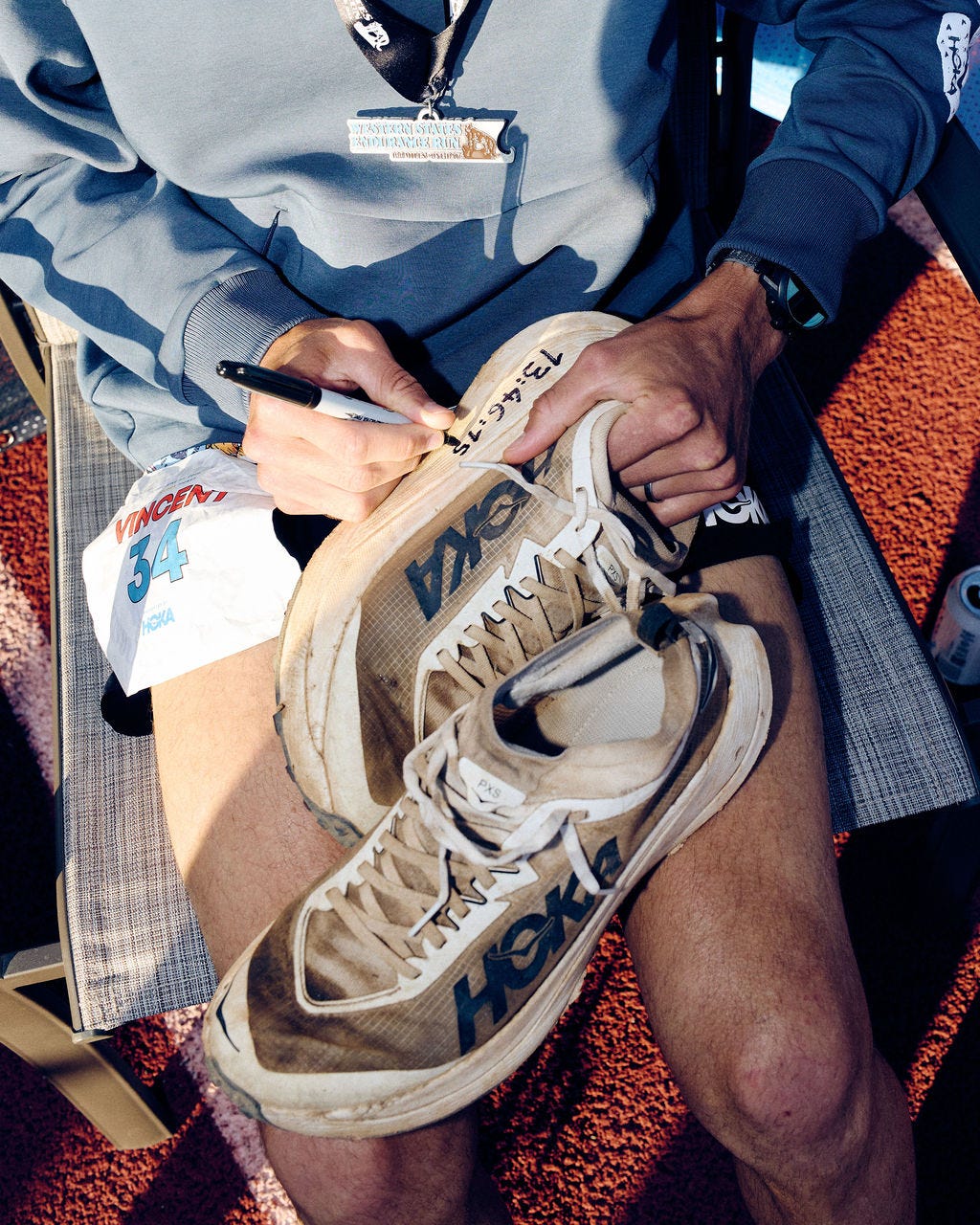
By the time Vincent Bouillard hit the streets of Auburn, it was inevitable. Word had gotten around that he’d passed fellow HOKA athlete Francesco Puppi near Quarry Road and built a big enough gap to win. A short climb after Robie Point, a downhill, and a few turns later, he appeared on the track, the crowd erupting as he closed out a historic day. He worked his way toward the finish, slapping hands with seemingly everyone in attendance before grabbing the tape.
13:46:15.
An almost incomprehensible time and the fastest in race history by 23 minutes. Puppi finished less than five minutes later (13:51:08), Ryan Montgomery less than three minutes behind him (13:53:55). On the women’s side, Jennifer Lichter bested Courtney Dauwalter’s previous course record by nearly 90 seconds, setting a new standard of 15:28:05.
This was more than a runner breaking the 14-hour barrier or a course record going down. It was a group of athletes pushing each other to their full potentials, and those of us spectating were lucky to be in the presence of greatness.
Western States began in 1974 as an offshoot of the Tevis Cup, a popular horse race that traversed the rugged trails from Tahoe to Auburn. As the story goes, Gordy Ainsleigh decided to run the course on foot after his horse pulled up lame, finishing in just under 24 hours. In the years that followed, more people attempted the race alongside the horses, until the Western States Trail Foundation was formed in 1977 and staged the first independent Western States Endurance Run in 1978, with 63 runners and 21 aid stations. The rest is history.
I had the privilege of attending this year’s WSER as a HOKA media guest. Over the course of the week, I spectated the race, immersed myself in the pre-race festivities, and chatted with HOKA employees, athletes, and other media guests. Each conversation offered an inside look at one of the biggest events in trail and ultra running, and at how HOKA views Western States: how the partnership informs marketing decisions, product design, athlete roster building, and more.
How did HOKA, once a French maximalist-shoe startup, end up presiding over a horse trail in the Sierra Nevada foothills? And how does it show up for the trail running community as a whole?
HOKA’s Rise
HOKA was founded in Annecy, France in 2009 by two former Salomon employees seeking a more cushioned trail shoe for faster descending. It quickly gained popularity across the running community for its combination of max cushioning and low weight.
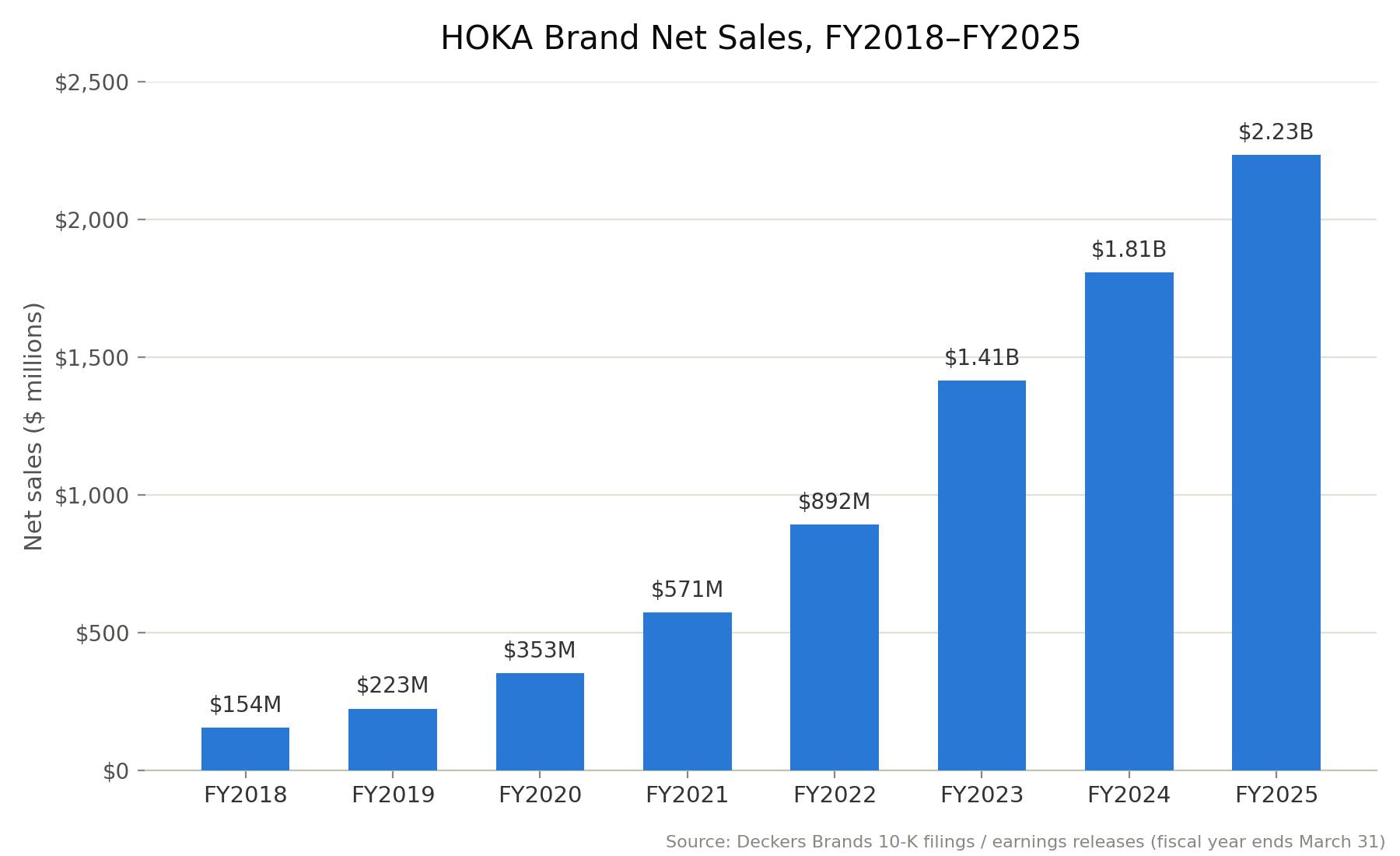
On April 1, 2013, Deckers Brands (parent company of Teva and Ugg) acquired HOKA. Since then, HOKA has become Deckers’ growth engine. Since 2018, the first year Deckers disclosed it as its own reporting segment, HOKA’s revenue grew from $153.5 million to $2.23 billion in fiscal year 2025, a 44% compound annual growth rate that helped vault it into the upper echelon of running brands.
On the heels of this growth, HOKA became the presenting sponsor of the Western States Endurance Run in 2019. The partnership was extended in 2024 and locked in through 2029. As I wrote about in “Western States is Not Just a Race,” this involves far more than a logo. The Western States Endurance Run Foundation relies heavily on contributions to fund the race, trail maintenance, and environmental research.

Speaking with Erika Gabrielli, VP of Global Marketing for HOKA, ahead of this year’s race, she underscored the relationship from the brand’s point of view:
“We truly work as partners with [the race] in terms of what are the challenges they are trying to overcome with the race? Once we lock in on those, we’re thinking about the broader athletes that are racing, but also what we’re doing on the community level.”
Western States also holds something the HOKA team sees as unique, an asset Gabrielli said the brand tries to leverage and magnify:
“[WSER] is the closest entry point to the heart of the sport, and particularly trail and ultra…You don’t really get it until you get there, and that’s really what we look for through sponsorship, to enhance that experience, to bring more people to the community and make it even stronger.”
At a more basic level, she summed up what it means to be the presenting sponsor of a race with this much history:
“Being the presenting sponsor for us is a way that we can certainly celebrate that community, invest in the race that means so much to so many, and show up in ways that really go beyond just branding. I think that is really HOKA’s secret sauce is the fact that if you come have an experience with HOKA — whether that is at an event, an activation, or even just with an employee — I think people walk away with something very special.”
I was intrigued, if slightly skeptical. Was this just marketing speak? Or was there truly something more to Western States that had to be experienced in person?
I was determined to find out as I set foot in Olympic Valley.
A Three-Part Activation
Based on my experience on the ground in Olympic Valley and in the lead-up to the race, HOKA’s Western States activation breaks down into three categories: athletes, product, and community.
Athletes: The Rookie and The Redemption
“We focus on our athletes first, just in terms of thinking about our athletes as an extension of our team, not just an asset. It’s not just a contract that we’re signing.” - Erika Gabrielli
HOKA’s athlete roster is arguably the most stacked in trail running, built from a mix of Western States champions and exciting upstarts. This year’s race showed HOKA making the same bet from both directions, exemplified by two athletes I spoke with ahead of the race, Ellaney Matarese and Adam Peterman.
According to Gabrielli, that contrast is by design:
“We have so many stories embedded in that and their journeys, everything from past champions who are working their way back from things they’ve overcome to someone that’s stepping to toe the line for probably the biggest moment in their career to date, which I think is so cool.”
Ellaney Matarese’s rise over the past 13 months is nearly unheard of. Just over a year ago, she was finishing her college career at Harvard. After graduating, she deferred medical school for a gap year, deciding trail running would be a fun way to spend it. Early success in a few local races gave way to a 6th-place finish at Kodiak 50K in October 2025, 7th at Black Canyon 100K in February 2026, and 5th at Canyons 100K, where she earned her golden ticket into Western States. Her signing with HOKA had just become public knowledge at the time we spoke.
Even she seemed surprised by her rapid ascent:
“I didn’t anticipate being here so quickly. I was coming off of competing in the NCAA last year, mostly as a middle distance runner.”
Still, she seemed unfazed by the prospect of signing a professional contract with one of the sport’s biggest brands ahead of her 100-mile debut at one of its most prized races:
“I almost feel like [signing with HOKA] takes pressure off. Getting a professional sponsorship feels like I made it, and it’s super exciting!”
On what would make her content looking back on the race:
“Success is really just knowing that I gave it everything I had and I left nothing out on the course.”


Matarese’s meteoric rise may only be rivaled by her fellow HOKA teammate’s initial introduction to the sport.
Adam Peterman needs no introduction to trail fans as a former Western States champion, having won the race in surgical fashion in 2022 as part of his own rapid ascent to the top of the sport. After battling injuries in 2023 and 2024, he returned to WSER in 2025, running near the front for 40 miles before losing his quads and walking it in for a sub-24-hour finish. In 2026, he returned via golden ticket with a more level mindset.
“I actually felt like the fittest I’d ever been going into [last year’s race]. It just seemed like everything was lining up. I think I carried too much emotion into it…This year I’m just going in knowing I’ve got to take care of myself. I’ve been training hard, and if I do that, I know I’ll have a good result.”
I asked Adam about his rapid rise in 2022, and his experience as a Western States champion both at the time and looking back years later:
“When I won Western States, obviously I knew that was a big deal, but I just didn’t realize, I guess, how much that meant in our trail running world.”
After getting injured in 2023 and missing the 2024 race, he pointed to his relationship with HOKA as something that helped carry him through:
“I had just signed a multi-year contract that essentially made me a professional runner. I didn’t need to have other work, so it was a big deal for me…And then I got that injury, and I had a call with them and was really nervous to tell them…There’s nothing in my contract that would make that injury end it, but you always want to perform for the brand that supports you…Long story short, they were really supportive like ‘don’t worry about it. We know what you’re capable of.’ That was nice because it took the pressure off me to come back fast.”
Both athletes also pointed to HOKA’s recent training camp in Flagstaff as a highlight. The gathering brought together HOKA’s entire elite trail roster, allowing for group training, personal bonding time, and knowledge sharing.
Peterman went on to finish 6th in 14:26:11, nearly 50 minutes faster than his winning time in 2022, while Matarese turned in an impressive 100-mile debut, finishing 16th in 17:54:04.
Product
Brands take several different approaches to building new trail shoes. Some iterate on existing styles, while others chase innovation and new technologies. HOKA’s approach with Western States was unique in that it set out to design a shoe purpose-built for WSER-style terrain. The result was the Rocket X Trail.


The shoe features a pared-back upper for breathability, responsive midsole, and minimal outsole. Perfect for the buffed out California carpet of Western States.
Matarese brought it up as a potentially crucial part of her race-day strategy:
“I’m probably going to start in the new Tecton X 4, and then I’m considering potentially changing into the Rocket X Trail at Forest Hill for the much more runnable, less technical section. It might be a game-time decision.”
Based on finish line photos, it appears she did switch to the Rocket X Trail.
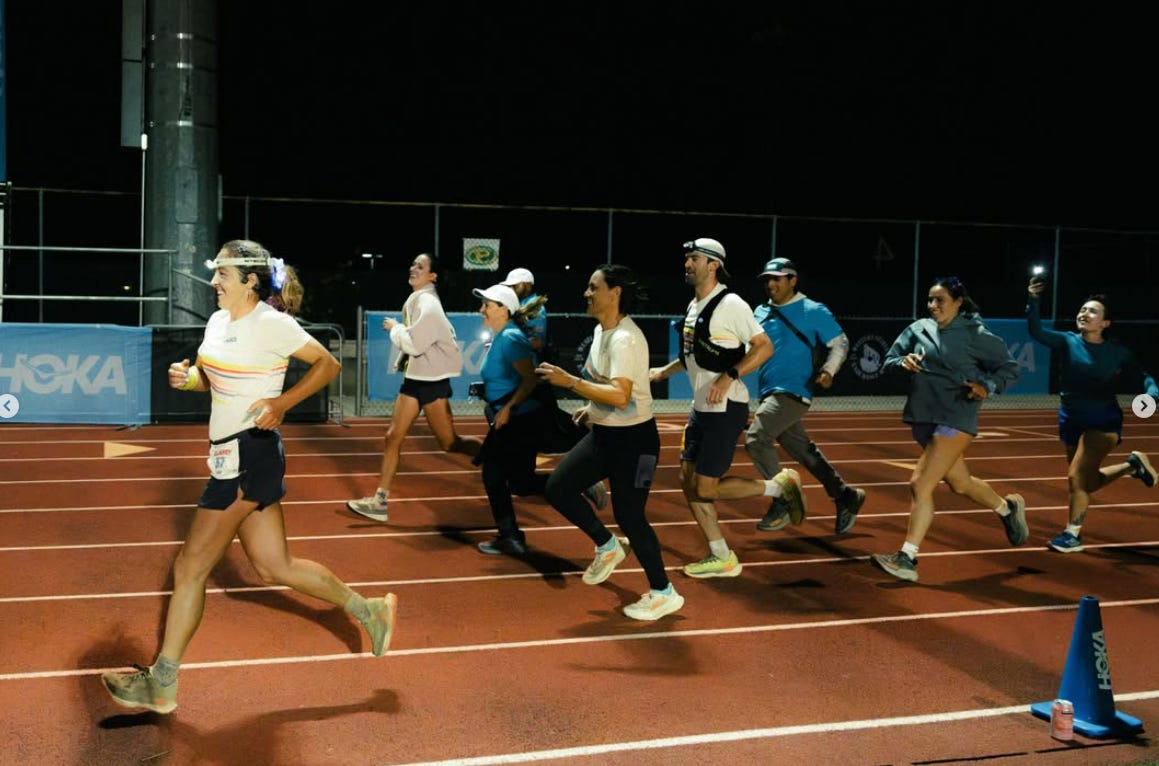
There’s perhaps no better example of HOKA’s product philosophy at Western States than the champion himself. Vincent Bouillard is a HOKA design engineer who wore a yet-to-be-released prototype — presumably one he helped design — on his way to a record-setting victory. His experience will likely help shape the final version as it heads toward for mass market release in the future.
Beyond the product on the feet of its athletes, race week also showed me how that same thinking showed up at HOKA’s Fly Lab activation in Olympic Valley. The brand hosted the pop-up near the start line at the base of the Escarpment, letting anyone in the valley demo the Rocket X Trail and newly released Speedgoat 7, including taking them up the first several miles of the course.
This was clearly by design. Gabrielli called those first miles a flagship experience:
“That race to the top of the mountain, when it starts in the dark and you come to the light, finding ways to make that an even better experience, it’s kind of once in a lifetime.”
The Fly Lab let fans and the broader community simulate climbing and cresting the Escarpment without disrupting the race itself.
Community
I was initially skeptical of the idea that HOKA had a “secret sauce,” not because I doubted it could be true, but because I’ve heard versions of this pitch before. With an analytical mind and a finance background, I find it difficult at times to fully grasp ideas that can’t be measured.
But some things need to be experienced to be understood.
Talking with Gabrielli and interacting with various members of HOKA’s marketing team and PR firm, it became clear that what I saw during race week was weeks, months, even years in the making, built alongside WSER’s own goals.
That effort was evident throughout Olympic Valley leading up to the race and on course on race day. Coffee Bar was remade to look like HOKA HQ, decked out in the brand’s signature blue with Western States references throughout the signage and menu. HOKA also hosted the High Camp Challenge, a free event letting participants experience the first three-ish miles of the race. Then there was the Placer High track and, of course, Golden Hour (more on that later).
HOKA branding was everywhere, but it never felt like too much. Even the pre-race press conference for four-time champion Jim Walmsley managed to feel both professional and intimate at the same time.


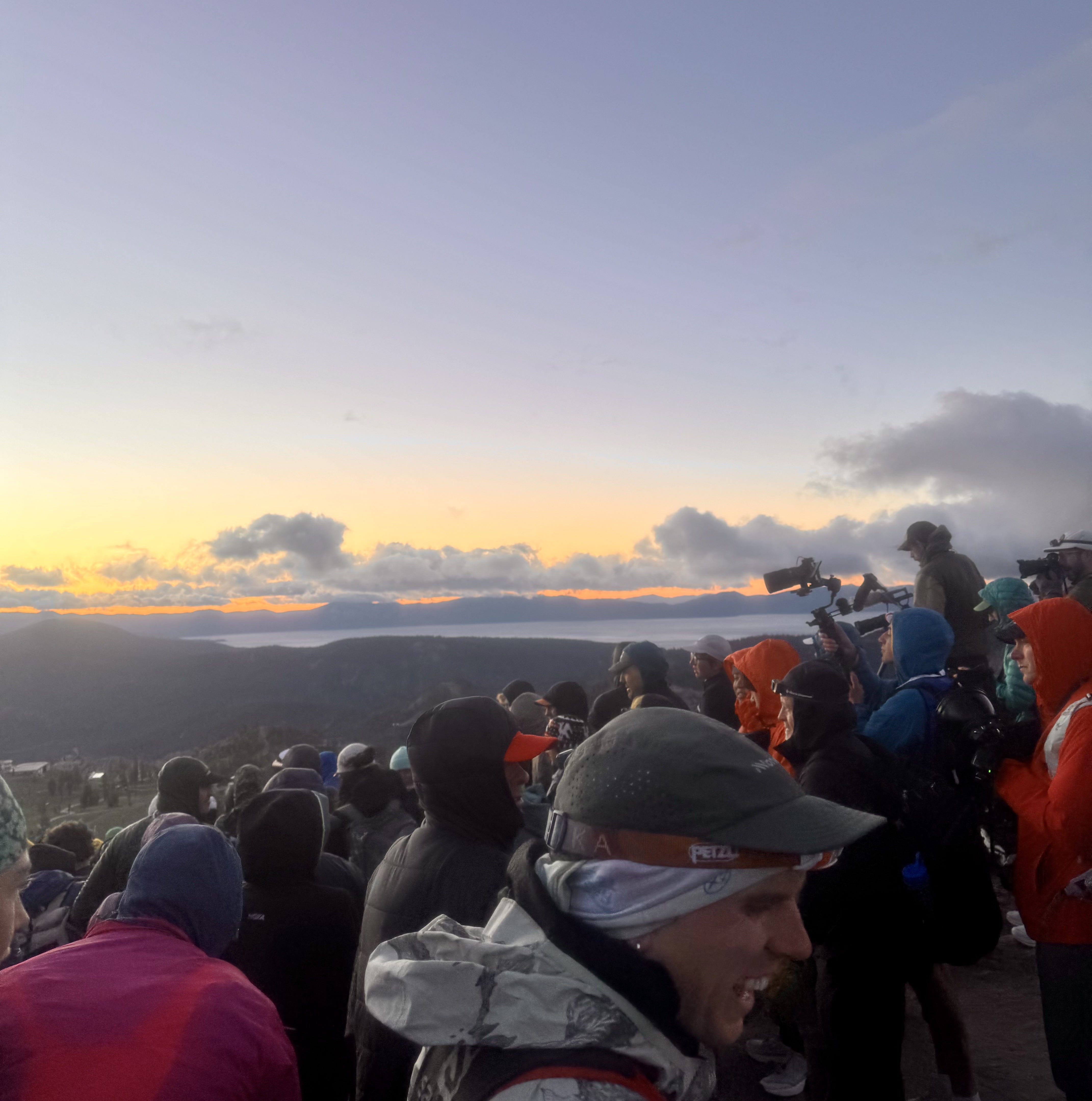
One detail really drove home HOKA’s understanding of both the race and the community. On race morning, hundreds of us set off from the start line at 3:30 a.m. to hike the first four miles and watch the leaders crest the Escarpment at sunrise. The weather was brutal, with real-feel temps of 32°F and wind gusts up to 65 mph at the top. About two-thirds of the way up, we came upon a pickup truck and a group of HOKA employees handing out coffee in Western States-branded mugs. The caffeine and the warmth were much needed, the mug is a keepsake I’ll hold onto, and the whole moment showed HOKA meeting the community where it’s at, suggesting there might be something to its secret sauce after all.
Scale as a Strategy
But warmth and good coffee don’t answer every tough question. The idea of a publicly traded global footwear company sponsoring one of trail running’s most grassroots institutions may strike some readers as cynical. HOKA’s revenue alone was almost $2.6 billion for FY 2026, while the WSER Foundation’s total operating budget comes in right around a million dollars.
HOKA is a large-scale organization presiding over arguably the most precious entity in trail and ultra running. That relationship needs to be handled with care.
“We don’t do this to be performative,” Gabrielli made clear. “We evaluate and think about true partnership. Every single individual that works behind the scenes is really sweating [the] details.”
Peterman underscored the same idea from the athlete side:
“At Worlds, they don’t have a sponsor. Like HOKA did not sponsor Worlds. They did have one of their employees out there, helping some of the European athletes, but you notice that it’s really helpful when HOKA shows up.”
On paper, a multi-billion-dollar company sponsoring a race run largely by volunteers might look like a mismatch. Based on what I saw, HOKA’s size doesn’t threaten the Western States experience. Instead, it amplifies the most authentic parts of the race and the community around it.
The Aura and Pull of Western States
After a week on the ground in and around Western States, there’s no doubt this race is special and something you have to experience in person to fully understand. As I made my way back from Tahoe to the Bay Area the morning after the race, I stopped by the Placer High track again to take in Golden Hour.
I wasn’t there for ten minutes before I started getting emotional. Tears streamed down my face as I watched runners come through the track with family and friends who’d been up all night supporting them, capping off a once-in-a-lifetime experience. Western States has been my bucket-list race for years, but standing at the track gave me a conviction I hadn’t had before. I need to — no, I will — make that same pilgrimage and finish on that same track someday.
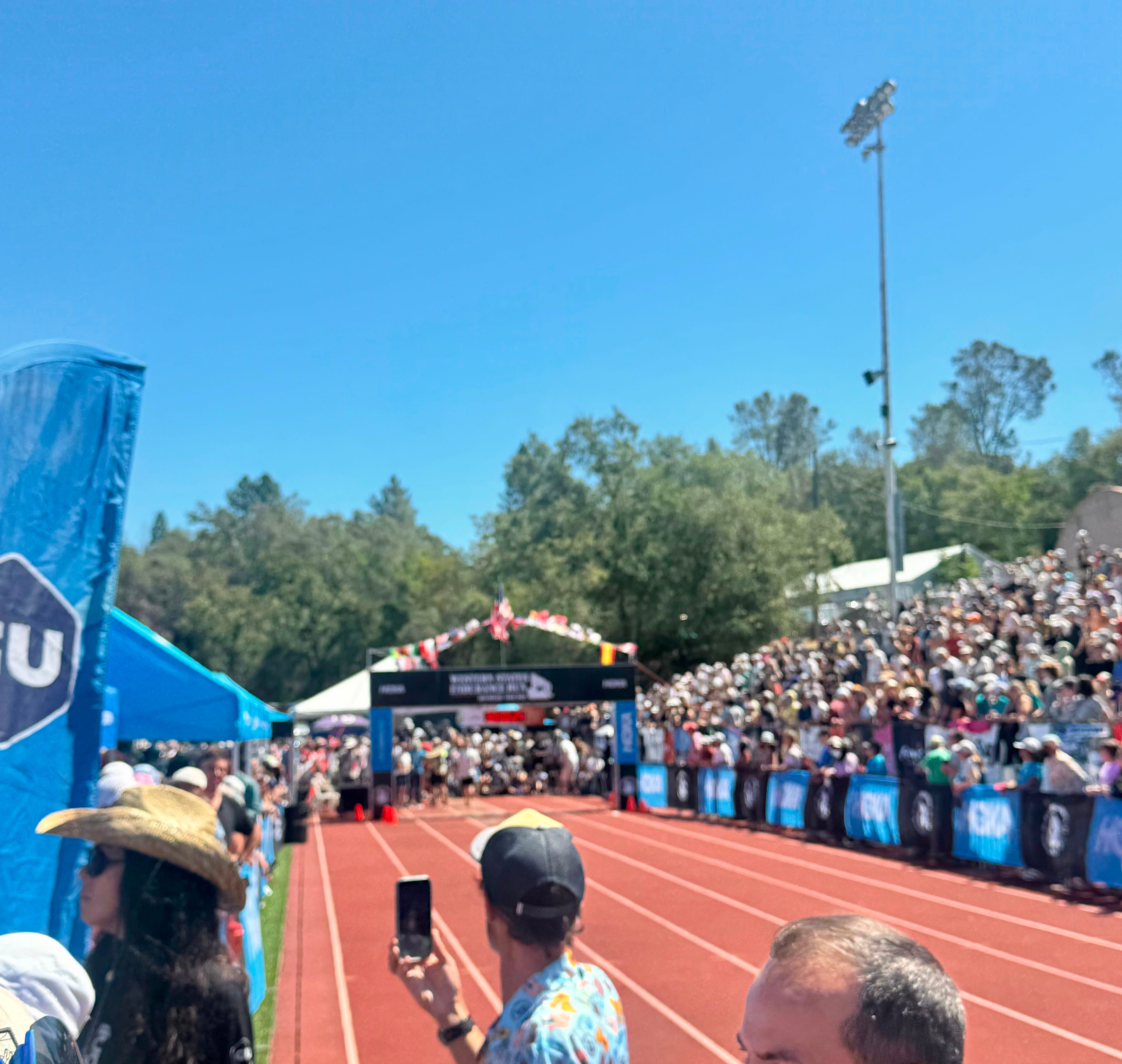
Western States is one of one. And what moved me most wasn’t the HOKA branding, the shoes, or even the sponsored athletes. It was watching people like me finish on the track, sharing that moment with loved ones while thousands of community members, fans, and professional athletes cheered them on.
I’ve visualized myself entering that track countless times. I’ve daydreamed about hearing my name on the loudspeaker as I hit the back stretch, my kids running alongside me around the final turn, hitting the final straightaway before slowing to a walk and finishing hand-in-hand. It’s a dream that takes years of qualifying races and some lottery luck to reach. But being there in person made me realize how close it actually is. I could see it, feel it, touch it. It’s only a matter of time until it’s mine.
I suppose my experience is part of HOKA’s special sauce. The brand didn’t create Western States. The race existed well before the current sponsorship and would continue on with another one. But HOKA’s support has helped amplify everything that makes it unique.
The way the brand keeps the community connected to the event lets all of us experience the magic, even if we’re not running. Whether you’re hiking up the Escarpment, taking in the scene in Foresthill, or watching runners finish on the track, you feel part of something much bigger than yourself.
That’s special, alright.
The Aid Station
Miscellaneous quick hits. Trail style. Actionable, digestible, essential.
🚤 A Busy Summer Outside Touching Grass
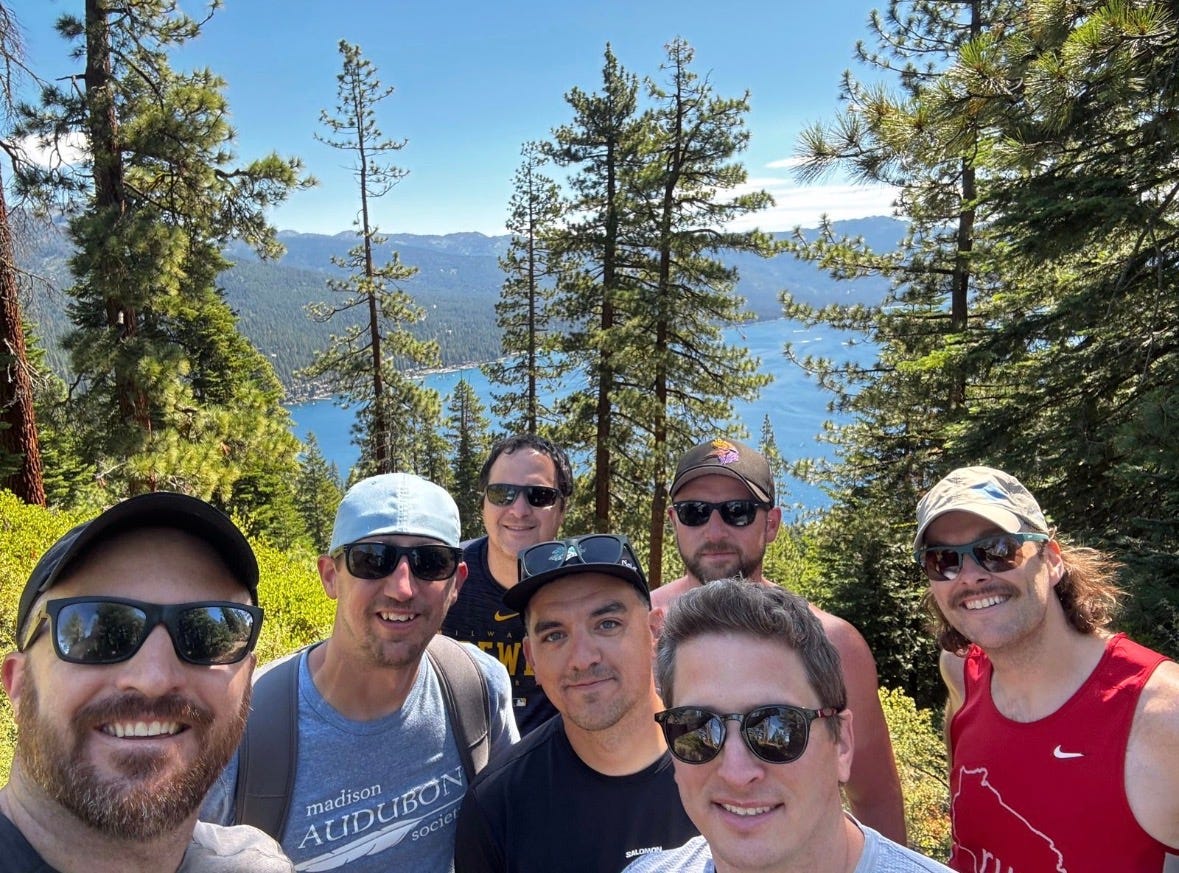
Dedicated readers may have noticed this is the first Trail Waves article in four weeks. It’s not that I haven’t been writing or haven’t been plugged into the trail world (I have). I’ve just spent a lot of time out of town, outside, and spending time with friends and family. It’s been soul-filling to unplug for a bit and be present for these fleeting moments, but I’m excited to get back to my normal routine.
🎥 “Unlocking the Impossible at the 2026 Western States 100-Mile Endurance Run” by HOKA TV
Speaking of HOKA, I really enjoyed this behind-the-scenes look at this year’s race. The film brings back to many memories from the day and does a great job summarizing what was a historic race.
Nice article Seth especially trying to capture the success that isn’t measurable with metrics
It’s good to have you back mate