

The Authenticity Economy: Rendezvu and the Next Wave of Trail Running Sponsorships
A three-sided marketplace. A new infrastructure where knowledge meets commerce. And a bet that genuine expertise is worth more than follower count.

Over the past several months, I’ve had more than a few people reach out asking for trail running recommendations. Shoes, apparel, nutrition. What brands do I use? What would I recommend for a newcomer to the sport?
I wouldn’t call myself an expert, but I’ve run enough miles, burned through enough gear, and consumed enough gels to have an informed opinion. Those experiences taught me that the best recommendations don’t come from Instagram ads or curated lists. They come from people you trust.
Purchase decisions in trail running are consequential. A shoe that doesn’t fit your foot or terrain isn’t just an inconvenience, it could impact your experience with the sport. Gear that doesn’t solve your problem can cost you money and decrease your enjoyment of the activity that got you outdoors in the first place. The people best positioned to help you get it right are the ones who have used the gear firsthand, across conditions and contexts. Athletes you follow. Running partners. The coach who’s watched you move. Not an algorithm.
The Problem
That experience is not unique to me. I’d bet it’s universal across trail running.
Outdoor gear is high-cost and high-stakes. The shoes, packs, technical layers, and nutrition an athlete chooses can be the difference between a solid day and a podium for elites, or the difference between a dream race and a DNF for the mid-pack. Each of these categories requires real guidance before purchase.
And trail runners take those decisions seriously. Readers of this newsletter may recall The State of Trail Running Report, which estimates the U.S. trail running market at ~$20B as of 2024, including ~$12B to ~$16B from footwear, apparel, gear, and nutrition alone. With a consumer base that skews affluent and highly educated, this is not a community that buys carelessly. It’s a community that buys deliberately and wants guidance when it does.
The people best positioned to give that guidance (athletes, guides, coaches) have no clean infrastructure to do it. Recommendations live and die in DMs, texts, Instagram stories, and trailhead conversations. That fragmentation creates a three-way dysfunction at the heart of the trail economy:
Brands can’t measure authentic influence that actually drives purchases.
Athletes can’t monetize the genuine knowledge that drives those sales.
Consumers either buy the wrong thing or don’t buy at all.
This isn’t an influencer problem. It’s a knowledge infrastructure problem. There has never been a centralized place where trail-focused experts can recommend gear, brands can track conversion, and consumers can connect with the athletes and voices they trust. A 2021 Nielsen study found that 88% of global respondents trust recommendations from people they know over any other channel, and 50% of people are more likely to trust a recommendation than ads or SMS messages. The infrastructure to act on that trust simply hasn’t existed.
That’s the gap Hunter Macy and Rendezvu are looking to fill.
What is Rendezvu?
Hunter Macy founded Rendezvu with a simple mission: get more people to enjoy the outdoors. His vehicle for doing that is an athlete recommendation platform (the company refers to athletes as “hosts” or “Rendezvuers”) that streamlines expert product recommendations so consumers can act on advice from athletes they trust, make confident buying decisions, and lower the barrier to getting outside.
But before diving into how it works, it’s worth understanding where the idea came from.
Based in Jackson, Wyoming, Macy initially came up with the idea for the company on a guided backcountry ski trip last winter. He was already working with guides on a separate problem related to fragmented booking and scheduling when he realized he needed additional gear. He found some options, asked his guide for input, and got three links back over text. He bought the gear and moved on. When he learned the guide made nothing from those recommendations, a lightbulb went off. Guides, athletes, and experts across outdoor sports have deep, authentic product knowledge and no infrastructure to share or monetize it.
Macy took the idea to local athletes in Jackson to pressure-test it, including versatile all-surface runner and Olympian skimo competitor Anna Gibson. Through these interactions, the pattern confirmed immediately. The founding thesis crystallized: build a platform for hosts to authentically share what they use, track what they influence, and earn from relationships they’re already building.
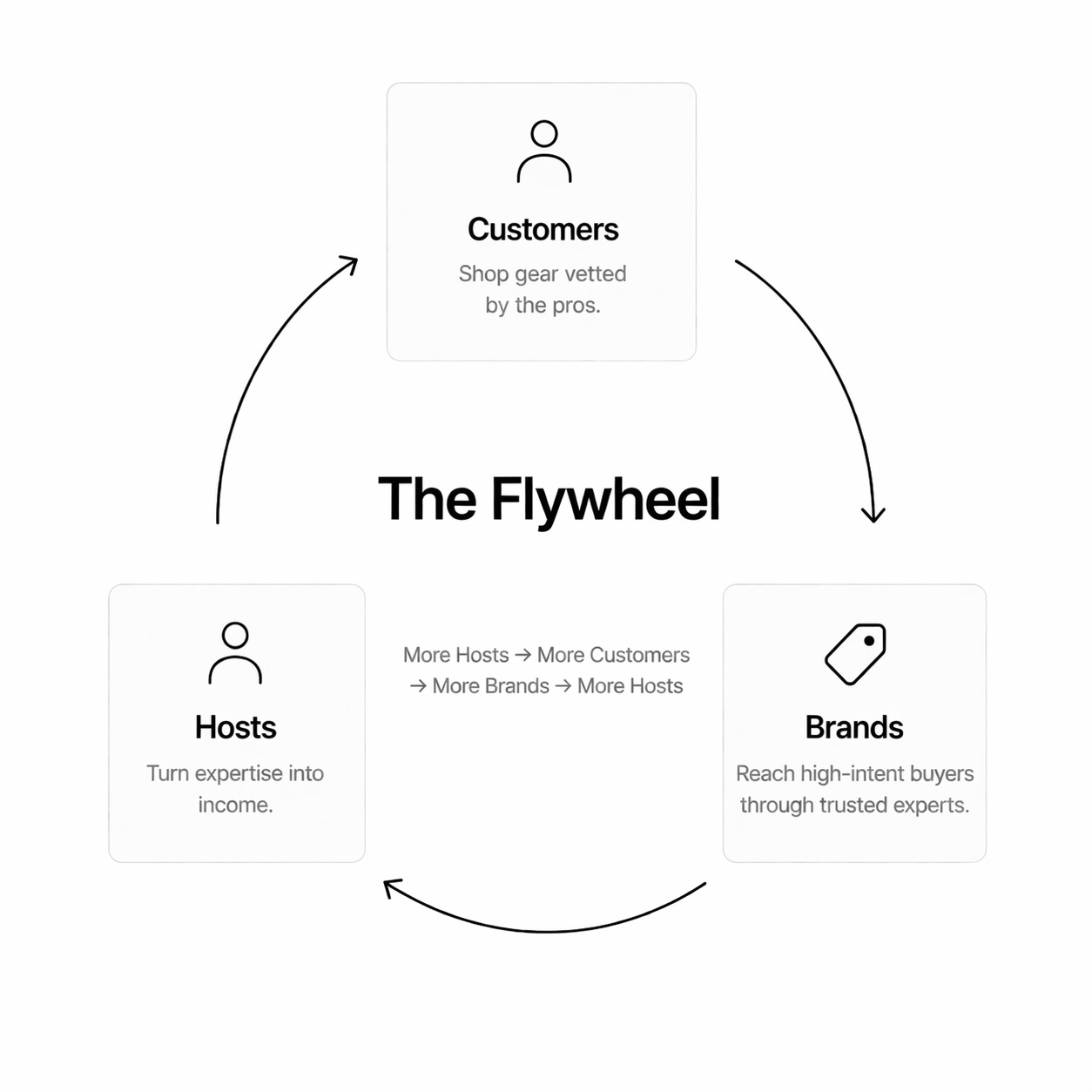
The result is a three-sided marketplace. Each side reinforces the others. More host recommendations attract more brands. More brands attract more hosts. More hosts build more consumer trust. The flywheel turns.
Rendezvu currently supports four sports: trail running, skiing, fly fishing, and climbing. Trail running is its primary focus over the next 6-12 months.
How It Works
To fully understand the Rendezvu platform, Hunter gave me a host account to experience it firsthand. Here’s how it works from all three sides of the marketplace.
The Host Experience
When you log in as a host, your first stop is your profile, a landing page that shows visitors who you are, which sport(s) you focus on, and the gear you recommend. Think of it as a storefront built around your expertise. Here’s mine:
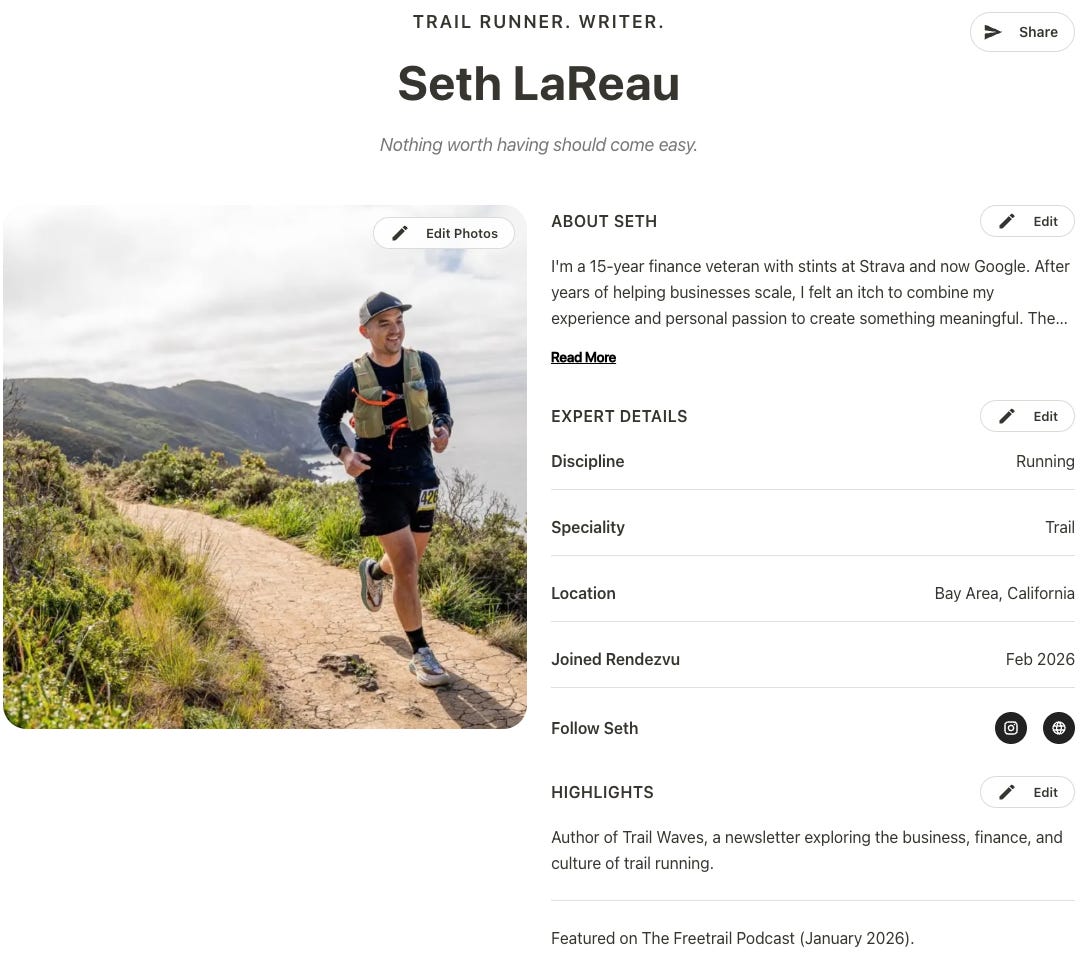
Adding gear is straightforward. As a host, you have two options: choose from one of Rendezvu’s current brand partners, or add any product you believe in regardless of whether the brand is on the platform. You click “Add to list”, paste the product URL, and you’re done.
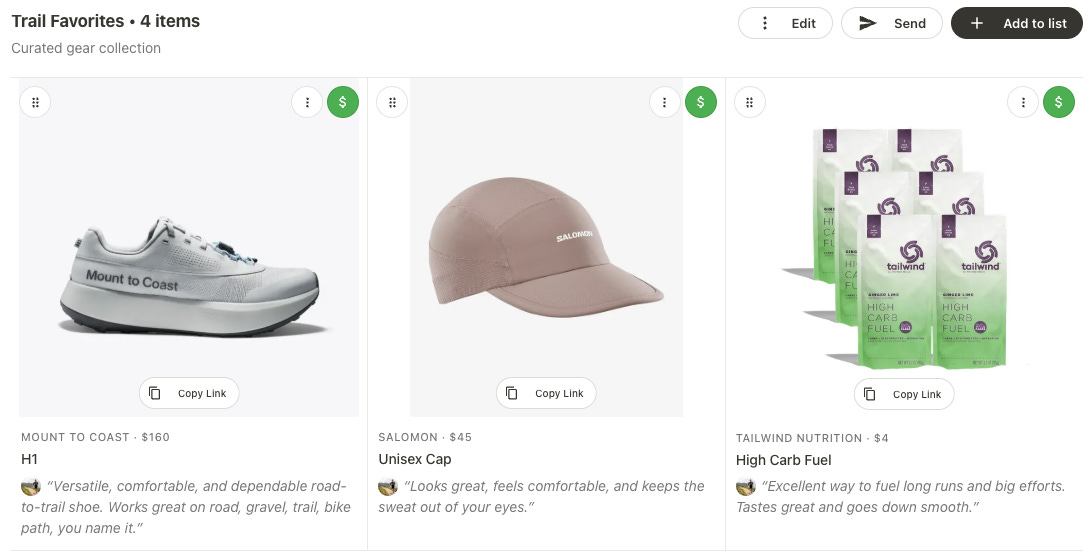
Partner products generate trackable commission links, meaning any purchases driven through your Rendezvu profile or any link you place elsewhere on the internet is attributed back to you. I’ve recommended a few products I’ve used recently, including the Mount to Coast H1s I raced Black Canyon 100K in and the Salomon cap I wore at Big Alta 28K, fueled by Tailwind High Carb. Anyone who clicks and buys through those links generates a trackable commission. Considerably less intrusive than an Instagram ad.
Adding non-partner products serves a different purpose. It signals to Rendezvu, and to the brands themselves, that there’s organic, unprompted demand on the platform. It’s natural lead gen for Rendezvu’s sales team and demonstrates high-intent interest in future partnership conversations1.
Hosts earn a guaranteed 10% commission on every partner sale attributed to the platform. Rendezvu takes a small cut on top of that, depending on the brand partnership.
The Brand Experience
In exchange for a monthly subscription fee, brand partners gain visibility into who is actually driving their sales. Not impressions, not follower counts, actual conversions. Brands can integrate via a full standard integration, through an affiliate partner, or for internal tracking only. There are currently 75+ partners on the platform, with notable trail brands including Brooks, Salomon, Mount to Coast, Janji, and Tailwind.
The Consumer Experience
For consumers, Rendezvu is simple. Follow athletes and experts you trust, see what they actually use, and buy with confidence. No algorithms, no paid placements, no guessing. Just authenticity and genuine domain expertise.
Why the Business Model Works
The economics here are worth pausing on. Brand subscriptions create a revenue floor with compounding stickiness. The more a brand integrates its data and partnerships into the platform, the harder it becomes to leave, while the recurring revenue keeps stacking for Rendezvu. Transaction-based commissions create the ceiling. As sales volume through the platform grows, revenue grows with it for Rendezvu, for partner brands, and for hosts.
The deeper advantage is the flywheel. More brands attract more hosts. More hosts build more consumer trust. More consumer purchases generate better brand data. Better brand data attracts more brands. At scale, any athlete can recommend and earn from any partner brand. Any brand can efficiently reach the high-intent buyers in any sport. Any consumer can get trusted recommendations from the athletes they already follow. Each side makes the others more valuable, and that dynamic gets stronger, not weaker, as the platform grows.
The Competition
Rendezvu isn’t operating in a white space. The affiliate-commerce market is real, growing, and raising capital at serious valuations.
ShopMy is the most formidable player, having recently achieved a $1.5B valuation. The platform seems to be built on fashion and cosmetics, and is only now making moves into the outdoor space. Faves.xyz is the next closest analog on the athlete side, though its focus appears to skew toward road and track. The rest of the field, including guide-focused, affiliate-focused, and creator/influencer-focused platforms, each take a slightly different angle on the same underlying problem.
None of them, Hunter would argue, are built around what Rendezvu is actually selling:
“Our competitors promote influence. Rendezvu promotes knowledge and authenticity… None of the competitors have the layer of trust that Rendezvu has already built and will continue to scale.”
That distinction matters most in a category like trail running, where gear decisions are genuinely consequential and trust is hard-won. Rendezvu is betting that 5,000 engaged, purchase-motivated followers can drive more brand value than 500,000 passive ones. In a high-intent market, that bet feels well-placed.
Growth Strategy
Building a multi-sided marketplace is a chicken-and-egg problem by nature. Brands come for high-intent users. Athletes need brands to recommend gear. Users need recommendations to make purchases. Those purchases reinforce the platform’s value to the brands, and the cycle continues. The challenge is getting the flywheel moving in the first place.
Rendezvu’s answer to this challenge is intentional, quality-first growth. Rather than chasing scale, they’re focused on earning deep trust from a small number of the right athletes, brands, and consumers, then using that foundation to grow outward. Two levers are doing most of the work right now.
Athlete Partnerships
Athletes are the platform’s core credibility engine. Recent additions include the aforementioned Anna Gibson, Mount to Coast athlete Cody Poskin, On athlete Alyssa Clark, and, most recently, professional trail runner and notable 200-mile phenom Kilian Korth.
The addition of Korth, known for winning the triple crown of 200-milers (Tahoe, Bigfoot, Moab) represents a meaningful signal. Hunter put it directly:
“Kilian's release shows that people care what others are recommending authentically and that translates into customers for the brands. Rendezvu also signifies that you don't need a ton of followers to show that people trust your opinion and prove that you'd be a valuable asset to a brand through your Rendezvu profile.”
That last point cuts to the heart of the platform’s thesis: authentic influence instead of raw reach.
Strategic Trail Race Sponsorships
Athlete partnerships build the supply side. Race sponsorships help build the community. According to Hunter, Rendezvu recently reached an agreement to sponsor the 2026 Broken Arrow Skyrace, a high-profile event with genuine trail running credibility, with additional sponsorships expected to follow in the coming months.
This strategy is straightforward. Show up where the community already exists. Meet potential hosts, brands, and consumers on their own turf before asking them to come to yours.
Why This Matters for Trail Running
Rendezvu is building toward a trend we’re starting to see more and more in the sport: race results alone don’t guarantee monetization for most athletes outside the top tier. I don’t mean that in a negative way. I’d argue it’s actually an opportunity for athletes, brands, and consumers alike.
Consider what each party in the trail ecosystem wants.
For Athletes
Athletes want to perform at their best without compromising authenticity or becoming a content machine. Not every athlete is comfortable building a personal brand on social media and they shouldn’t have to be.
Rendezvu gives hosts a simple tool to demonstrate buying influence in trackable terms by recommending gear they already use and believe in. No manufactured content, no inauthentic #Ad posts. Just a profile, a gear list, and transparent payment tracking.
To succeed as a sponsored athlete means genuinely supporting your brand, and if you genuinely love their products, Rendezvu makes it easy to show that.
For Brands
Brands increasingly want to know whether their sponsorship dollars are actually moving product. That question hasn’t always had a clean answer. Rendezvu gives brands real conversion data, including who is recommending their gear, how those recommendations are performing, and which athletes are already driving sales organically.
Having one place to manage partnerships, track conversions, and measure authentic influence can deliver more value than legacy sponsorship campaigns built on reach metrics that don’t tell the full story.
For Consumers
Trail runners are trying to figure out what to buy without wading through inauthentic sponsored posts or wasting money on gear that doesn’t suit their needs. Rendezvu lowers that barrier by connecting consumers directly with athletes they already trust, helping them buy the right thing the first time. Less money wasted. Less time deciding. More time outside.
The trail running industry is moving toward metrics that matter. Rendezvu is positioning itself as the infrastructure at the center of that shift.
Looking Ahead
According to Hunter, this is the future of athlete and brand partnership.
“The industry is going this way. You might as well hop on the wave, try as many things as possible, and have an opinion too.”
Athletes who understand their commercial influence now, while staying authentic, will be better positioned than those who figure it out later. But real questions remain. Can quality and authenticity hold as the Rendezvu network scales? What does Rendezvu look like when it’s operating across every sport category, not just trail running?
Hunter’s answer is characteristically direct:
“Rendezvu in 3-5 years will represent athletes, guides and coaches in all sport categories in a way they never have been before. They will have a reference point to show brands their value right away. Adoption rates by the brands and athletes will be the driving teller for us because as we continue to onboard more brands onto our subscription tier we realize that’s how we can provide this community more value: by giving the brands direct access to the products the athletes recommend and fostering that connection straight from Rendezvu.”
The vision is clear. The flywheel is turning. Now comes the hard part: keeping it authentic as it scales.
The trail running community should be paying attention.
The Aid Station
Miscellaneous quick hits. Trail style. Actionable, digestible, essential.
🐓 Freetrail: “The Big Alta 100k 2026 Highlight Video”
Forgive my Bay Area bias here, but the Big Alta 100K has to be on the short list for most scenic 100K trail races in the world. Add in the point-to-point route, historical Marin landmarks, and the perfect beauty-to-difficulty ratio (~13,000 feet of gain/loss), and you have an instant classic of race. So excited for the future.
Major kudos to Ryan Thrower for creating this banger of a highlight video. I promise it’s worth the time. Congrats to Freetrail, Daybreak, and everyone else involved with this wonderful race!
Speaking of Freetrail and Daybreak, their other spring showcase (Gorge Waterfalls) is on deck for this weekend. With three distances and $75,000 in total prize money, it’s sure to be an exciting weekend of racing.
🎥 Molly Seidel x Maurten: “take the show off the road”
I really enjoyed the behind-the-scenes view of Molly’s Black Canyon 100K race. The narrative and context provided in this film give the finish line emotions that much more depth. I didn’t think it was possible, but I’m even more stoked for Western States now.
📹 Max Jolliffe x BPN: “The Spirit is Willing”
Always a compelling subject, Max is back with a film documenting his 5th place finish at the MAMMOTH. I found it interesting to see how the race unfolded, including the parts that weren’t visible from the outside. It’s clear Max loves this stuff and is constantly learning with each race.
As an example, I added the Tantrums Crest 6 Hydration Vest even though Tantrums is not an official Rendezvu partner at the time of publishing.
Great concept as someone who’s sick of the conflation between pro ultra runners and influencers/content creators, the latter of which focuses a tiny bit on performance and a lot a bit on pushing product.
The idea sounds great, but the cynic in me can't help but feel conflicted. Seemingly, the definition of an athlete is sponsored? If this is the case, do their recommendations actually lead to any change in the authenticity of the recommendations?